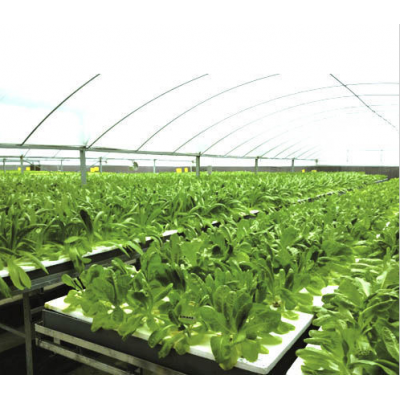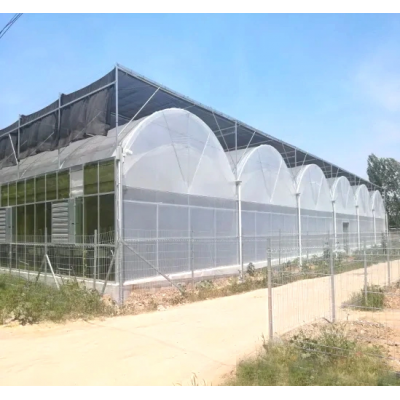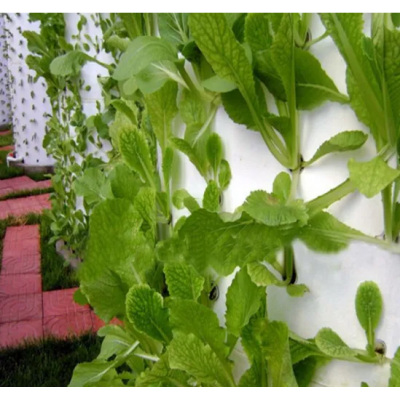


This tower is a vertical aeroponic growing system for commercial leafy production, with white food grade PVC towers carried on galvanized steel support pipes and LED grow lights set above the crop. The plants sit in the tower wall rather than in a bed, so the same floor area carries a multiple of the plants, and the lights let the house run a full day rather than following the season. The support frame sets the row spacing and the working height, so the towers can be lifted out for cleaning.
A vertical growing tower is a way of buying floor area without building more of it. The house already has the height, so moving the crop into the tower means the same footprint carries a multiple of the plants, and adding a grow light on top means the crop is no longer limited to the length of the day outside.
In a bed layout the crop sets the footprint, because rows, aisles and working space all take floor. Putting the plants into a tower wall moves them into vertical space the house was already paying for, and it puts them at a working height so the crop can be reached and harvested from an aisle instead of from a crouch.
Lighting is the second change. With LEDs above the towers the crop runs on the hours the grower chooses rather than on the season, so a leafy crop can be scheduled to a delivery date instead of to the calendar. Hydroponic growing laid out under cover is grouped on the hydroponic system range page on this site.

The towers are white food grade PVC, which keeps the root zone cool and the working area bright, and they are carried on galvanized steel support pipes rather than standing free. The support frame sets the row spacing and the working height, and the lamps are hung from the same frame above the crop so the light falls on the plants rather than into the aisle.
Because the crop grows up a wall rather than out across the floor, the light from a lamp reaches more plant for the same fitting than it would in a bed layout, and the air moving through the house passes between the towers instead of over a closed canopy. That combination is what makes the layout work in a house that was built for horizontal rows.

The feed is automated, so the system runs on a cycle rather than on someone opening a valve. Solution is delivered to the towers on a timer or a sensor, the tank is topped up and dosed on the same schedule, and the surplus is collected and returned rather than running to waste. Running the loop closed is what keeps the water and the fertiliser inside the house.
Because every plant on a tower shares the same solution, the system is only as even as its flow. Filters, the pump and the return are the parts that keep it even, and a blocked filter or a pump running slow shows up along the row rather than at one point, which is why they are serviced on a schedule. A layout built on the same principle at floor level is described in the industrial grade nutrient film technique system.

The table below is the standard build. Tower spacing, support height and the control package are set to the house and to the crop.
| System type | Vertical aeroponic tower, recirculating |
| Tower material | Food grade PVC |
| Tower colour | White |
| Support frame | Galvanized steel pipes |
| Lighting | LED grow lights carried above the towers |
| Feeding | Automated pump cycle with dosing and tank top up |
| Drainage | Collected at the tower base and returned to the tank |
| Crops | Leafy vegetables, herbs, strawberry, flowers and microgreens |
| Use | Inside a greenhouse or a controlled growing room |
| Customisation | Tower spacing, support height and control package set to the house |

The system arrives as towers, support pipe, fittings and the control set, and is assembled in the house rather than fabricated on site. The support frame is set out and levelled first, because the row spacing and the working aisle are decided at that point, then the towers are placed, the feed and return are connected, and the lamps are hung on the frame above them.
Maintenance is the water, the flow and the light. Filters are cleaned and the tank is checked on the same cycle as the crop, the return is flushed when the house is turned over, and the towers are washed between crops so root material does not carry from one planting to the next. Lamp output falls with age, so the fittings are cleaned on a cycle and replaced on the manufacturer schedule rather than when a crop looks stretched.

Systems of this type are used for commercial leafy vegetable production, for herb and microgreen work, and for strawberry and flowering crops where a clean root zone and a controlled day length matter. They suit growers who are short of floor area rather than of height, operations that need the crop scheduled to a delivery date, and houses that expect to add cooling, dosing or a larger control layer to the same layout later.
Research and innovation material on horticulture and controlled environment growing is published by Wageningen University & Research. Agricultural sourcing and production information for growers is published by Wikifarmer. A tower layout built around a different crop is described in the automated hydroponic tower system for soilless tomato.
Floor area. The house already has the height and was paying for it, so putting the crop into a tower wall means the same footprint carries a multiple of the plants, and they sit at a height that can be worked from an aisle.
So the crop runs on the hours the grower chooses rather than on the season. That lets a leafy crop be scheduled to a delivery date, and because the crop grows up a wall the light from a fitting reaches more plant than it would over a bed.
The PVC towers and the galvanized support frame are both built for long service under normal growing conditions. The pump, the dosing unit, the filters and the lamps run on their own service cycles.
We provide a 10 year structural warranty and a 5 year anti-corrosion warranty on the galvanized support. Details are set out in the contract for each project.
Send your house dimensions, the crop you plan to run and the light hours you need. We reply with a layout drawing and a full quotation.