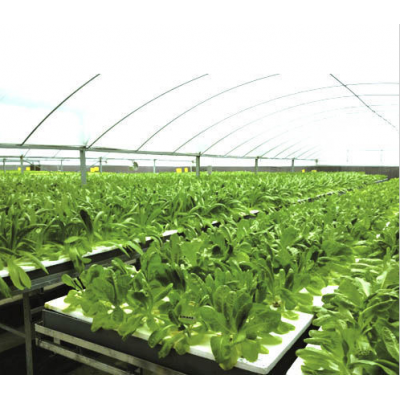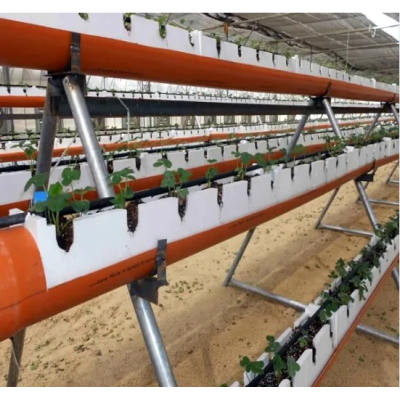


A vertical tower takes the growing area and turns it into volume. The crop is carried on stacked columns rather than spread over a bed, so the same square metre of floor holds several times the number of plants, and the columns are modular, which means the port density follows the crop rather than the other way round. The solution is pumped to each root zone through the column, and the drainage is balanced so every level is fed the same.
On a strawberry or lettuce programme the constraint is usually floor, not water. A tower solvesthat by growing upwards: the crop is carried on stacked columns with the solution delivered to eachlevel, so the same footprint carries several times the plant count and the crop is worked standingup.
The change is volumetric rather than linear. A bed increases with floor area, and a tower increaseswith height, so a house that has run out of bed space can add capacity without a new building. Thatmatters most where the structure is already paid for and the growing system is the only thing beingextended.
Growing without soil also removes the soil-borne disease pressure a field crop carries, which isthe reason a hydroponic crop is usually sprayed less than the same crop in the open. It is not that asoilless crop cannot get disease, but that the cycle that carries it through soil is broken. Towers ofthis family sit with the rest of the hydroponics system range on this site.

The columns are a modular stack, so the number of growing ports is set by how many sections areused and the spacing is chosen against the crop. A herb or microgreen programme wants ports closetogether because the plants are small and the crop is cut; a fruiting crop wants more room per plantand fewer ports per column, because the plant has to be supported and picked.
Crops are set into the ports in net pots, so a column is replanted by lifting one pot and settingthe next rather than by emptying a bed. On a short cycle crop that is what keeps the turnaroundbetween plantings measured in days, and it is also what makes the same tower usable for a differentcrop without changing the structure.

The pump moves oxygenated solution to each root zone and the drainage is balanced so that thelevels do not run at different rates. That balance is the part that decides whether a tall columnworks: if the flow is not equalised, the top of the column runs wet and the bottom runs dry, and thecrop on one column finishes at two different times.
The column and the ports are food grade PVC, UV stabilised so the material does not warp or degradeunder continuous irrigation and daylight. Food grade matters because the solution is in contact withthe material for the whole season, and UV stabilisation matters because a column that warps changesthe fit of the pots and starts leaking at the joints.

The table below is the standard build. Column count, height and the pumping package are set to the house and to the crop.
| Growing method | Vertical hydroponic tower, soilless |
| Column construction | Modular stack, port density set by crop |
| Column material | Food grade PVC, UV stabilised |
| Colour | White |
| Feed | Oxygenated solution pumped to each root zone |
| Pump | Quiet submersible pump, low energy |
| Drainage | Balanced across all levels |
| Support pipes | Galvanized steel pipes |
| Crops | Strawberry, lettuce, herbs, leafy vegetables and microgreens |
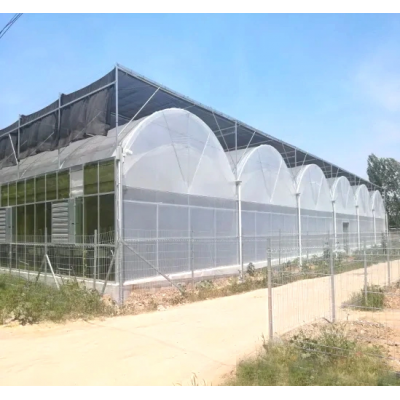
| Installation | Fits an existing greenhouse or growing room |
| Customisation | Column count, height and pumping package set to the site |

The tank, the pump and the manifold go in first, then the columns are set on a level base andplumbed to it. Columns are stacked section by section, so the assembly is a repetition rather than abuild, and the crop is set in the pots after the system is wet, because the ports are easier to loadwhen the column is standing and the flow has been checked.
Maintenance is the pump intake, the filters and the drainage. The intake is cleared on a shortcycle, because a partly blocked intake changes the flow at the top of the columns before anything isvisible. Filters are cleaned on the crop cycle, and the columns are washed through between plantingsso root material does not carry over. The pot fit at each port is checked at the same time, since aloose pot is where the next leak starts.

Towers of this type are used for strawberry and lettuce production at high density, for herb andmicrogreen programmes where the crop is cut rather than picked, and for houses that have run out ofbed space and want to add capacity without building. They suit commercial growers moving a crop ontoa channelled root zone, operations extending a block one bay at a time, and projects where the growingsystem is specified before the house. An aeroponic tower fed by mist rather than by a pumped film isdescribed in the aeroponic tower with mist spray page.
Research and extension material on controlled environment horticulture is published by Cornell University. Farming and horticulture reporting for growers is published by Krishijagran. A tower supplied with a drip irrigation pump kit is described in the plant tower hydroponic system with drip irrigation pump kit page.
Because capacity then increases with height rather than with floor area. A house that has run outof bed space can add plant count without a new building, and the crop is worked standing up.
Yes. The columns are a modular stack, so port density is set by the number of sections and thespacing chosen against the crop. A herb programme runs them close together; a fruiting crop wants moreroom per plant.
The galvanized support steel is rated for 15 to 20 years under normal growing conditions. Thecolumns are UV stabilised and run for several seasons, and the pump, filters and pot fitments areconsumables replaced on their own cycles.
We provide a 10 year structural warranty and a 5 year anti-corrosion warranty on the galvanized steelwork. Details are set out in the contract for each project.
Send your house dimensions, the crop you plan to run and the plant density you are aiming for. We reply with a layout drawing and a full quotation.