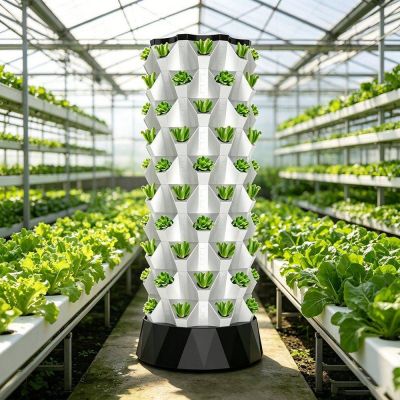


A plant tower is a way of using height instead of floor. The crop is carried on stackable rings rather than spread across a bed, so a small footprint holds a large number of plants, and the solution is delivered to the top and works its way down through every level. This set arrives as the whole working loop: the tower, a submersible pump, a timer and the net pots. Because the ring sections stack, the height of the tower is set on site rather than fixed at the factory.
Floor area is the constraint in most growing houses, and a vertical system answers it by building the crop upwards. A plant tower carries the plants on stacked ring sections with the solution delivered at the top, so the same square metre holds several times the number of plants it would hold on a bed, and the crop is reached standing rather than bent over.
A tower is a set of stackable ring sections rather than a single moulding, which means the height is decided on site. The rings are drilled to take net pots, so the planting density follows the crop: herbs can be set close on a short tower, and a leafy crop given more room on a taller one. Because the sections stack, a tower can be built out in stages as a crop plan fills, or reduced for a trial. Towers of this family sit with the rest of the hydroponics system range on this site.

The solution is pumped to the top of the tower and drip fed down through the sections, so each level receives what the level above did not take. That is the part that decides whether a tower works: a tower fed only at the top without even distribution leaves the lower rings running dry, and a tower fed unevenly grows differently on the sunny side. The pump is a submersible unit that sits in the tank, and the timer sets the cycle.
Because the feed comes from a tank rather than from a line of emitters, a tower set is simple to extend. A second tower is added to the same tank and the same timer, and the cycle is adjusted for the extra volume rather than for a second control point. A tower system built onto a fixed frame is described in the automated hydroponic tower system page.

Solution that the plants do not take up runs back to the tank rather than away, so the volume of water used is the volume that evaporates and what the crop holds. On a tower that return is continuous, which keeps the solution moving and stops it going stale in the base of the unit. Nutrient strength is set in the tank and monitored there rather than at each level, so one reading covers the whole tower.
The catch is that a tower is a single path. A blocked feed at the top starves every level below it, which is why the pump intake and the filters are the parts to keep clean. On a commercial block the towers are run in groups off separate tanks, so one group can be taken out for service without stopping the house.

The table below is the standard set. Tower height, ring count and the pumping package are set to the house and to the crop.
| Growing method | Vertical tower, soilless |
| Included | Tower rings, submersible pump, timer and net pots |
| Ring sections | Stackable, up to 8 layers |
| Tower material | Food grade PVC |
| Wall thickness | 1.8 mm to 2.0 mm |
| Colour | White |
| Support pipes | Galvanized steel pipes |
| Feed | Top fed drip distribution through every level |
| Circulation | Submersible pump on a timer cycle |
| Water system | Recirculating; deep water culture or aquaponic loop |
| Crops | Lettuce, herbs, leafy vegetables, flowers and microgreens |
| Customisation | Tower height, ring count and pumping package set to the site |

A tower is set on a level base, because the sections stack and a tower that is out of plumb loads one side of the ring joints. The tank goes in first, then the pump, then the rings are stacked and the net pots set, and the timer is set to the cycle for the crop. Towers are usually laid out in rows with a working aisle between them, so the crop can be reached at each level without moving the unit.
Maintenance is the pump intake, the filters and the ring joints. The intake is cleared on a short cycle, because a partially blocked intake drops the flow at the top of the tower before anything visible changes. Rings are separated and washed at each crop change so root material does not carry over, and the joints are checked for seating at the same time. The timer is worth keeping a spare for, since a tower fed from one pump has no second path.

Tower sets are used for lettuce and herb production on a short cycle, for leafy vegetables and microgreens where the crop is cut rather than picked over, and for blocks where the floor is expensive or limited. They suit commercial houses adding capacity without a new building, operations that want the same tank and timer to serve several towers, and projects where the growing system is specified before the house is built. A tower built for soft fruit and leafy crops is described in the commercial hydroponic grow tower page.
Standards for equipment and installations are published by NEN. Market and sourcing information for agricultural buyers is published by Wikifarmer.
It depends on the ring count and the planting spacing, both of which are set on the order. The rings stack, so a tower can be built to the height the house allows and the drilling set to the crop.
The crop dries out quickly, because a tower has no second path to the roots. That is why the timer and the pump are the parts worth keeping a spare of, and why commercial blocks run towers in groups off separate tanks rather than all from one.
The galvanized support steel is rated for 15 to 20 years under normal growing conditions. The pump, the timer and the ring set run on their own service cycles and are replaced as they come due.
We provide a 10 year structural warranty and a 5 year anti-corrosion warranty on the galvanized steelwork. Details are set out in the contract for each project.
Send your house dimensions, the crop you plan to run and the growing layout you intend to use. We reply with a layout drawing and a full quotation.