

A rolling bench is a way of taking the walkways out of a nursery. Instead of leaving an aisle beside every bench for the life of the house, the benches run on rails and push together, so the aisle is opened where someone is working and closed again afterwards. The top is a 2 mm galvanised wire mesh on a galvanised frame, which is what keeps the surface from rotting in the humidity of a seeding house. Length and width are set on the order, and the handwheel at the end is what moves the row.
In a nursery the crop is raised and moved rather than grown in place, and the part of the building that earns nothing is the aisle. A rolling bench removes most of it: the benches run on rails and push together, so the walkway exists only where someone is working and the floor carries more trays for the rest of the day.
On a fixed bench layout every row needs a route to it, and those routes stay empty whether or not anyone is using them. Rolling benches are pushed apart to work a row and closed back together afterwards, and the movement is made by a handwheel at the end of the bench rather than by lifting anything. Because the row is moved rather than walked around, the operator works from one position and the trays are not carried.
That matters more on seedlings than on a finished crop. A tray that is handled repeatedly loses plants, and every lift is a chance to drop one or to disturb a root plug that has just knitted. Pushing a bench is gentler than carrying a tray. Benches of this family sit with the rest of the hydroponics system range on this site.

The frame and the top are galvanised steel, with a 2 mm wire mesh surface. A mesh top is used rather than a solid tray because a seeding house runs wet: the mesh lets water pass and air move under the tray, so the surface does not sit damp, and a galvanised frame does not need recoating in the humidity that would take a painted one off in a season.
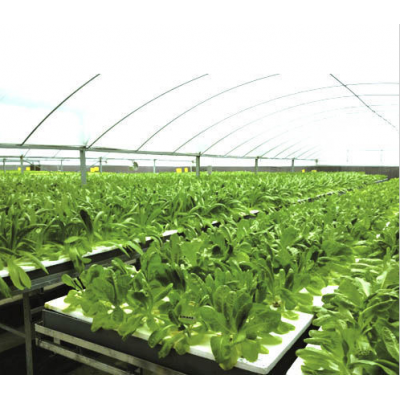
Because the surface is open, it also suits ebb and flow, where the bench is flooded and drained rather than watered from above. The mesh carries the tray clear of the water once the bench has drained, which is the point of the method: the root zone is wet on a cycle and aerated in between.

Ebb and flow works by flooding the bench to a set depth and then letting it drain. The tray takes up what it needs from below, and the solution that is not taken returns rather than being lost, so the water used is the water the crop holds plus what evaporates. On a bench layout the flood and drain are run from the end of the row, which is why a movable bench has to keep its connection flexible.
The method suits seedlings and short cycle crops because the root zone is never left saturated. A flood that lasts too long, or a drain that is blocked, is what causes trouble on this system, so the drain and the level control are the parts to check first rather than the feed.

The table below is the standard build. Length, width and the movement arrangement are set to the house and to the tray size.
| Product type | Movable ebb and flow seedbed bench |
| Frame material | Galvanized steel |
| Bench top | 2 mm galvanized wire mesh |
| Finish | Anti corrosion coating for high humidity houses |
| Movement | Handwheel drive, rolling on rails |
| Length | Customizable |
| Size | Set to the house and the tray |
| Irrigation | Ebb and flow flood and drain |
| Water use | Recirculating; unused solution returns to the tank |
| Application | Greenhouse hydroponics, seeding and flower growing |
| Documentation | Installation and use instructions supplied with the shipment |
| Customisation | Length, width and layout set on the order |

The rails go down first, because a rolling bench needs a flat run for the full length of its travel and a bench that is out of line binds at one end. Rails are set to the layout and levelled, the bench frames are built up on them, and the handwheel drive is adjusted so the row runs without being forced. The flood and drain connections are made at the end of the run, with enough slack for the movement.
Maintenance is the moving parts and the water. The rails and the drive are cleared and checked at the start of each season, since grit on a rail is what makes a bench hard to push and then wears the wheels. The mesh top is checked for bent or broken wires, because a damaged top holds a tray at an angle and the crop in it drains unevenly. On the ebb and flow side the drain, the level control and the filters are cleaned on a short cycle.

Rolling benches are used for seedling and plug production in vegetable and flower nurseries, for herb and leafy crop programmes raised on trays, and for any house where the crop is moved between zones as it grows. They suit a nursery that wants more trays on the floor it already has, an operation replacing fixed benches at one end of a house at a time, and projects laying out a new seeding house from the layout drawing. A raised bench system built in layers is described in the multi layer growing bench page.
Industry news and standards work for commercial horticulture is published by AIPH. Farm input and market reporting for growers is published by Agriwatch. A fixed bench built for seed raising is described in the seeding bed page.

Because the aisle is the part of a nursery that earns nothing. Rolling benches push together so the walkway is only open where someone is working, and the movement is made with a handwheel rather than by carrying trays.
Because a seeding house runs wet. A mesh top lets water pass and air move under the tray, so the surface does not stay damp, and it also suits ebb and flow, where the bench is flooded and drained and the tray needs to sit clear of the water afterwards.
The galvanized steel frame and mesh are rated for 15 to 20 years under normal growing conditions. The wheels, the drive and the flood and drain fittings run on their own service cycles and are replaced as they wear.
We provide a 10 year structural warranty and a 5 year anti-corrosion warranty on the galvanized steelwork. Details are set out in the contract for each project.
Send your house dimensions, the crop you plan to run and the tray size you intend to use. We reply with a layout drawing and a full quotation.