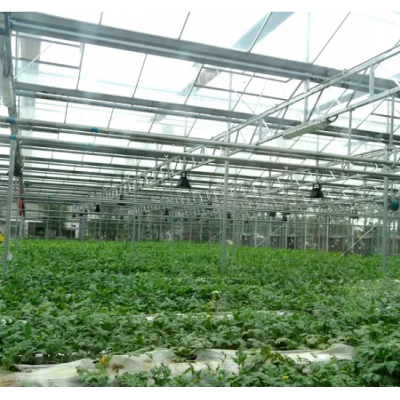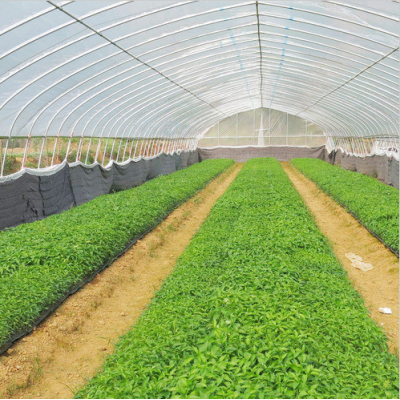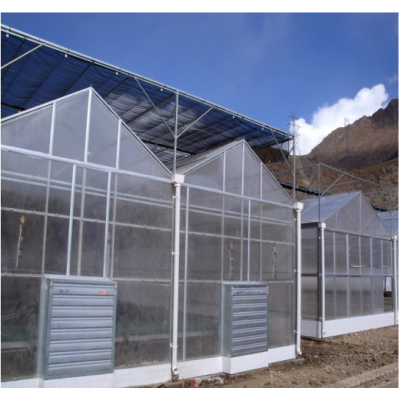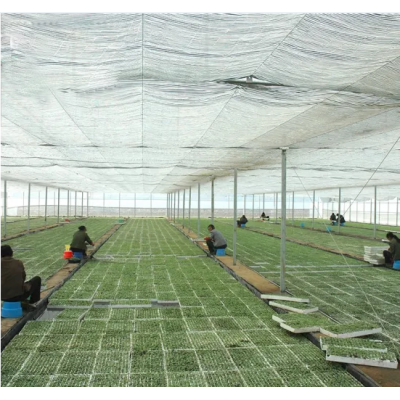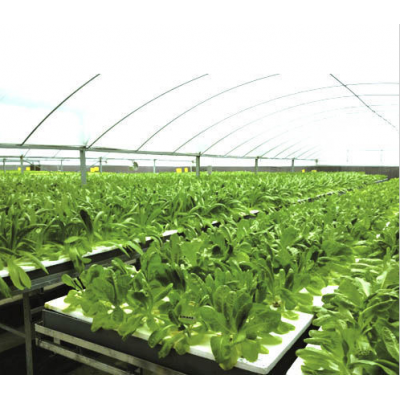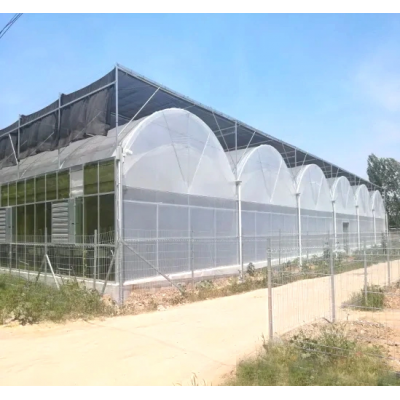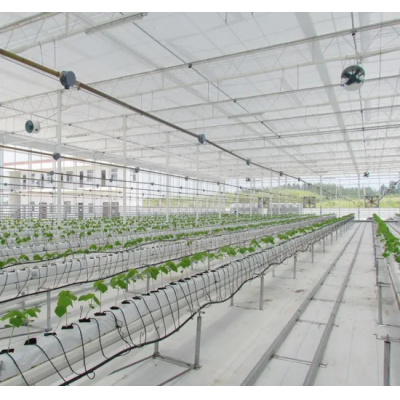


This system is built around the feed rather than the frame. Nutrient strength and acidity are held by automatic control instead of by hand testing, so the solution the crop receives is the solution that was set, whether or not anyone is in the house. It is designed to go into a greenhouse that already exists, so a grower can put the water side in without replacing the structure, and the climate sensors let the same controller follow the conditions in the house rather than running to a fixed timetable.
On a hydroponic crop the water is the crop, and the part of it that goes wrong quietly is the strength of the solution. A tank that starts the week at the right figure does not finish the week there, because the crop takes water and nutrients at different rates as it grows. This system is arranged around measuring that and correcting it, rather than around a mixing schedule.
Nutrient strength and acidity are held by control rather than by hand. Stock concentrates are dosed into the tank against a reading, so the solution stays where it was set through the day and through the week instead of drifting until someone tests it. On a cucumber or pepper crop that matters because the plant is being pushed for fruit over a long season, and a root zone that swings shows up first as uneven fruit rather than as a visible fault.
The same control follows the climate. Sensors in the house feed into the controller, so the irrigation cycle is called by the conditions the crop is actually in rather than by a clock that was set in spring. Systems of this type are grouped on the hydroponics system range on this site.

The pH and EC readings are the inputs, the dosing pumps are the outputs, and the set points sit between them. Where the system is fitted to a house that already runs hydroponics, the control layer is added to the existing loop rather than replacing it, which is the usual route for a grower upgrading a working system instead of building a new one.
Calibration is the part that decides whether any of it can be trusted. A sensor that has drifted will be acted on by the controller exactly as if it were correct, so probes are cleaned and calibrated on a routine and replaced when they stop holding a reading. The dosing pumps are calibrated on the same visit.

The channels are white food grade PVC, 1.8 mm to 2.0 mm thick, in 2.9 m and 5.8 m lengths or cut to order, and can be set as one flat layer or stacked in several layers on galvanized steel frames. White is used for the channel wall because a dark channel warms the solution on a sunny day, and because the root condition can be read through a white wall without lifting the plant.
Channels are drilled to the planting spacing on the order, so the layout follows the crop rather than the other way round. Where the feed is delivered to a bench rather than to a channel, the same approach is described in the drip irrigation system page.

The table below is the standard build. Channel count, layer arrangement and the control package are set to the house and to the crop.
| Growing method | Recirculating hydroponics, soilless |
| Nutrient control | Automatic dosing to pH and EC set points |
| Climate input | House sensors linked to the same controller |
| Retrofit | Control layer can be added to an existing system |
| Channel material | Food grade PVC |
| Channel thickness | 1.8 mm to 2.0 mm |
| Channel length | 2.9 m, 5.8 m or cut to order |
| Channel colour | White |
| Layer arrangement | One flat layer or multiple layers |
| Support pipes | Galvanized steel pipes |
| Water system | Recirculating; deep water culture or aquaponic loop |
| Crops | Cucumber, pepper, lettuce, herbs and microgreens |
| Customisation | Channel count, layers and control package set to the site |

The frames and channels are set out first and levelled, since the channel has to fall towards the return. The tank and the pump go in, the loop is connected, and the control layer is commissioned on a wet system so the set points are read against a running circuit rather than a static one. Sensors are installed in the flow, not in a corner of the tank, and the dosing pumps are calibrated at commissioning.
Upkeep divides into the mechanical and the measured. Filters and the pump intake are cleaned on a short cycle, because a partly blocked filter changes the flow at the far end of a run before the controller can see anything. Probes are cleaned and calibrated on their own routine. Channels and the tank are washed between crops so root material does not carry over, and the controller log is read after each change to see how the season actually ran.
Systems of this type are used for greenhouse cucumber and pepper production over a long season, for lettuce and leafy crops on a short cycle, and for herb and microgreen programmes where the solution has to be consistent from one batch to the next. They suit a grower upgrading the water side of a house that is already working, an operation adding houses to one control point, and projects where the crop is pushed for fruit and the root zone has to be held steady to carry it. A system built for cucumber and tomato houses is described in the custom hydroponic growing system page.
Standards for equipment and installations are published by DIN. Production and technology reporting for commercial greenhouse growers is published by Greenhouse Grower.

Because the strength of the solution drifts once the crop starts taking water and nutrients at different rates. Control keeps it at the figure it was set to, so the crop is fed to a plan rather than to whatever the tank has become by Thursday.
Yes. The control layer is added to the existing loop rather than replacing the channels and the frames, which is the usual route for a grower upgrading a working house rather than building a new one.
The galvanized support steel is rated for 15 to 20 years under normal growing conditions. The sensors, dosing pumps, controller and channel set run on their own service cycles and are replaced as they come due.
We provide a 10 year structural warranty and a 5 year anti-corrosion warranty on the galvanized steelwork. Details are set out in the contract for each project.
Send your house dimensions, the crop you plan to run and the growing layout you intend to use. We reply with a layout drawing and a full quotation.