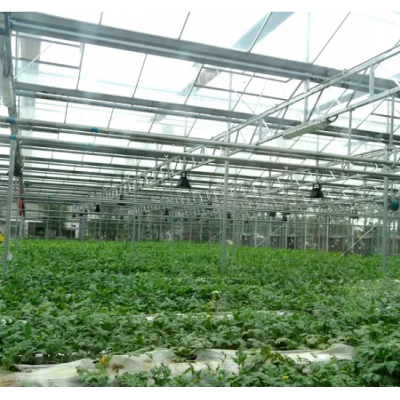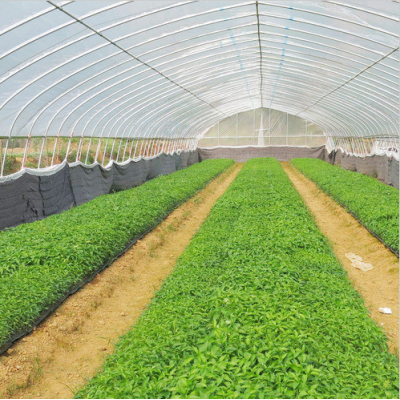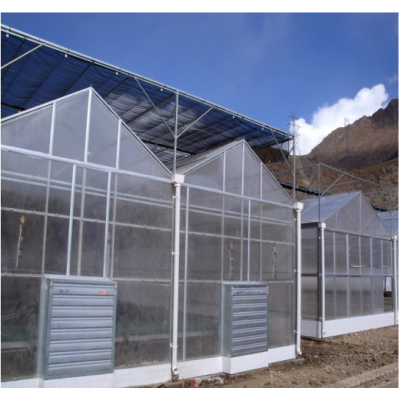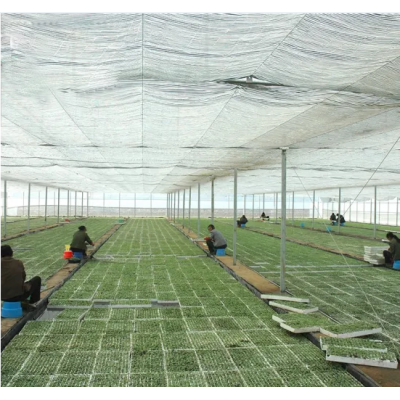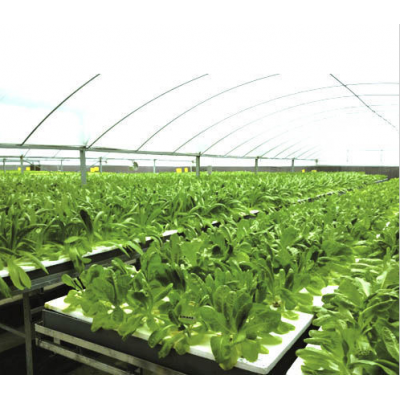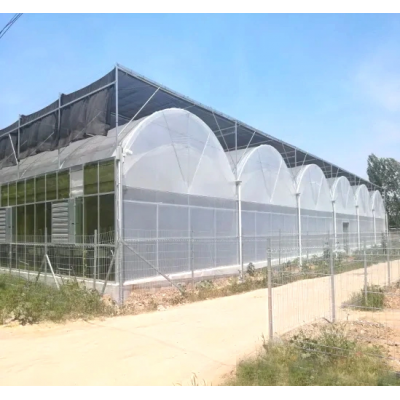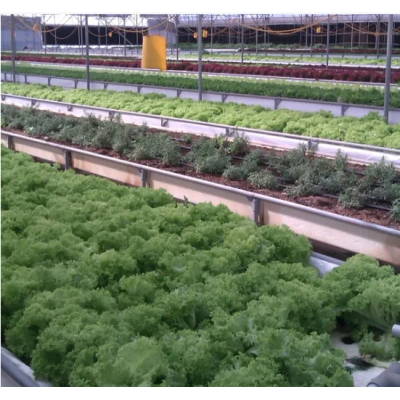
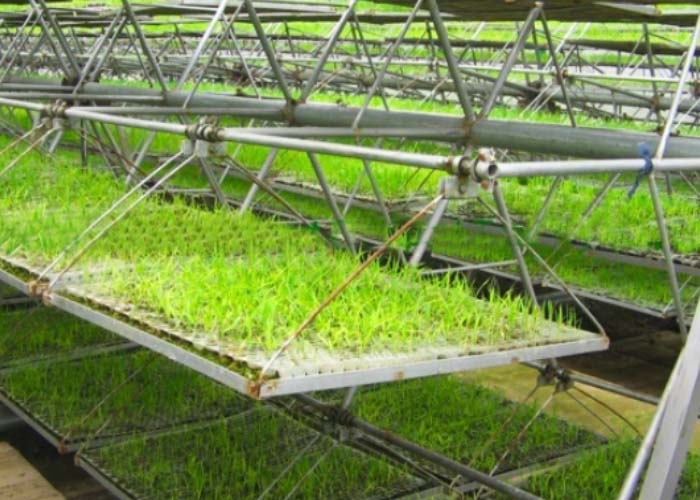
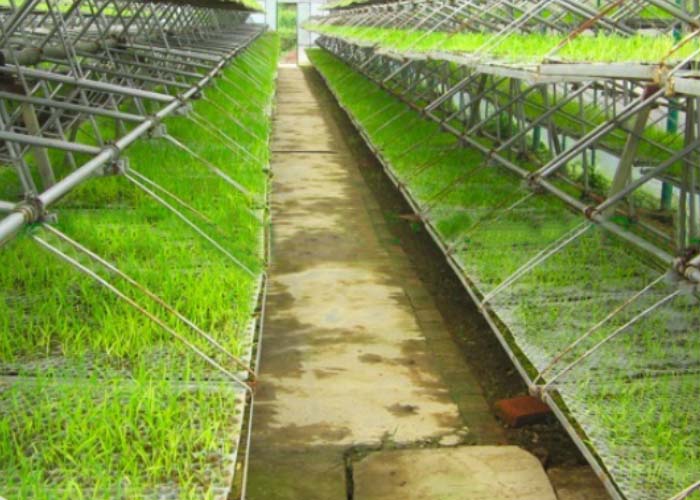
A multi-layer growing bench turns the air above the floor into growing space. Trays are stacked in four levels on a bench support, and the whole stack is served from the aisle, so a single-span house that would carry one layer of plants on the ground ends up with close to double the planting area. Each support measures 1.55 m high, 32 m long and 1.1 m wide, and ten of them fill a 9.6 m by 68 m house. Because the movable levels slide out on power drive, light and irrigation reach every tray evenly rather than favouring the top layer, and the whole change of position runs from a microcomputer instead of from a crew walking the house.
Floor space is the limit on how many seedlings a nursery can raise, and once the land is paid for it is the most expensive square metre on the site. A multi-layer growing bench attacks that limit from above: the same house, the same roof and the same floor, with the growing trays stacked in levels instead of spread out in a single sheet.
Trays are carried on levels above the ground, so planting area grows upward instead of outward and the utilisation ratio of the greenhouse rises to nearly 200%. The gain shows up as land saving, easier management and a lower cost per plant, which is why the bench is used in seedling and propagation houses rather than in open production. Because the levels are served from the aisle, crews work standing up rather than bending over floor beds, and the trays stay off the ground and away from soil splash.
Each support carries four layers of movable bench. Three of them can be pushed out by power drive for about 0.8 m, while the benches on the top layer stay fixed. That movement is what evens out the light and the irrigation between the upper and lower trays, which is the part a static rack cannot do: without it the top level shades the one below and the trays dry at different rates. Position changes are handled automatically through microcomputer control, so the whole cycle runs without anyone walking the house to shift trays by hand. For a bench built around the seeding stage specifically, compare the seeding bed version of the same idea.
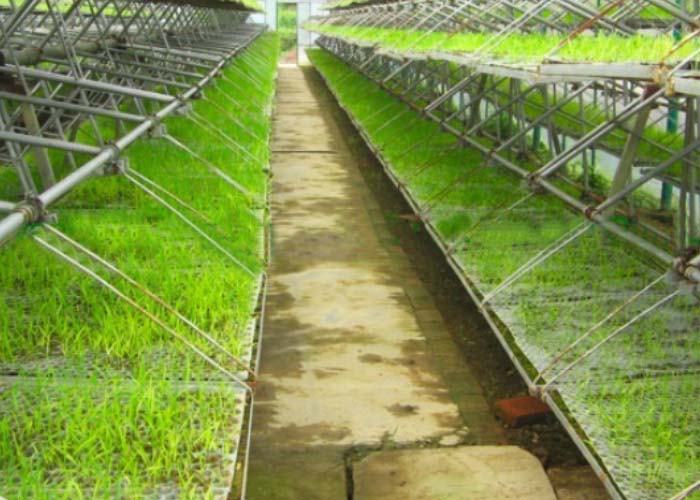
The bench support is 1.55 m high, 32 m long and 1.1 m wide, and ten supports are used in a single-span greenhouse measuring 9.6 m by 68 m. Four movable layers are fitted to each support, and each layer carries 58 planting trays of 540 mm by 880 mm, giving 232 trays across the four layers. The house covers 652.8 m² of ground, while the planting tray area reaches 1,280 m² - calculated as 32 m x 1.0 m x 4 layers x 10 sets. The layout is set from a bench drawing so the aisle width, the drive side and the irrigation positions are fixed before the house is ordered.
The structure arrives as frame members, rollers, drive components and trays, and is assembled inside the house following the layout drawing. Once running, the routine is simple: keep the roller tracks and drive chain free of soil and debris, confirm the levels still travel their full distance, and check the tray supports for any deformation when trays are loaded unevenly. Irrigation fitted above the bench should be checked at the same time, which is why bench systems are usually specified together with the irrigation system range. For nurseries that raise seedlings in trays before they are bench-loaded, see the nursery seed tray greenhouse.
The bench suits vegetable seedling nurseries, flower and ornamental propagation, research and trial houses that need repeatable conditions, and off-season propagation where the same floor has to produce more trays than a flat bed can hold. Guidance on protected cultivation and nursery practice is published by USDA, and protected cropping developments are covered by HortiDaily.
The utilisation ratio of the greenhouse rises to nearly 200%. In a single-span house of 652.8 m² the planting tray area reaches 1,280 m², because trays are carried on four levels instead of being spread across the floor.
Three of the four layers can be pushed out by power drive for about 0.8 m, while the top layer stays fixed, and the position change runs automatically from a microcomputer. The movement is what gives the upper and lower trays even light and even irrigation.
The hot-dip galvanized steel frame is designed for a 15-20 year service life in normal agricultural environments, with a double-sided zinc coating of 200-275 g/m². Film covers are replaced every 3-5 years, while glass and PC panels carry their own manufacturer warranties.
The hot-dip galvanized steel frame carries a 10-year structural warranty covering structural safety, plus a 5-year warranty against corrosion perforation. It is designed for a 15-20 year service life, and film covers carry a 3-5 year UV warranty depending on grade.
Send your house dimensions, the tray size you plan to use and the number of trays you need per cycle. With that we can set the number of supports, the layer count and the aisle width, and return a quotation with a bench layout drawing and a bill of materials.