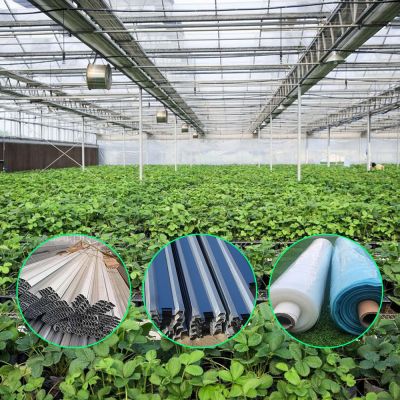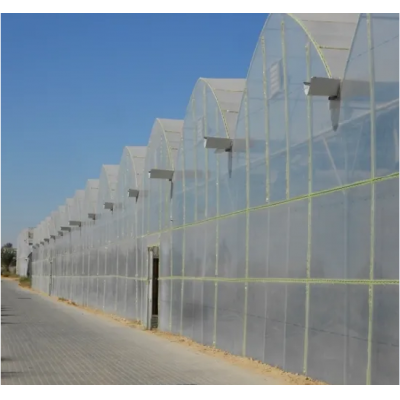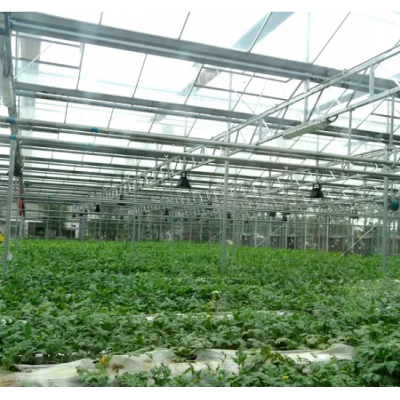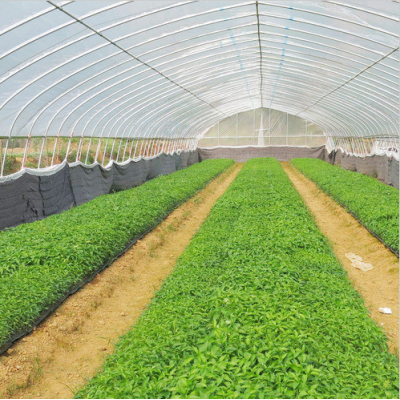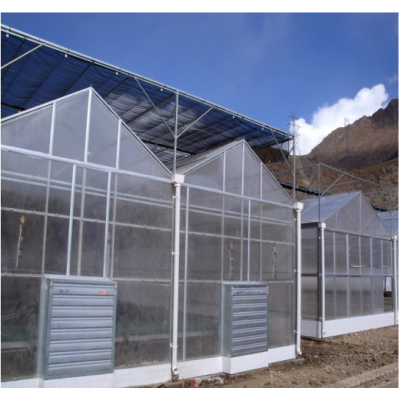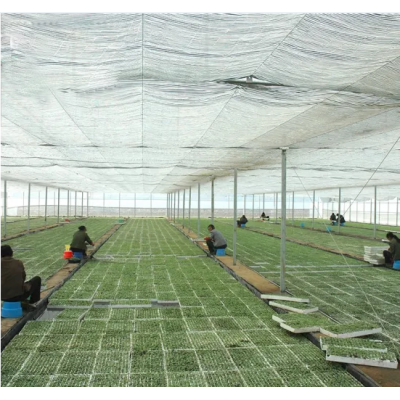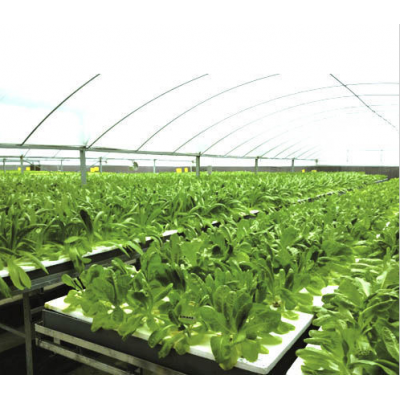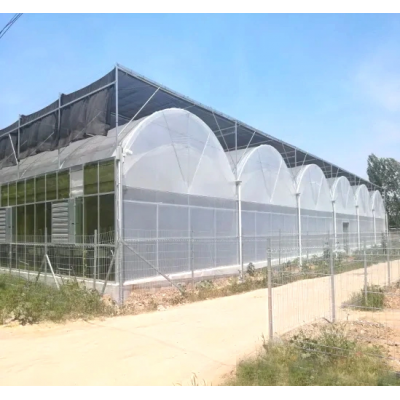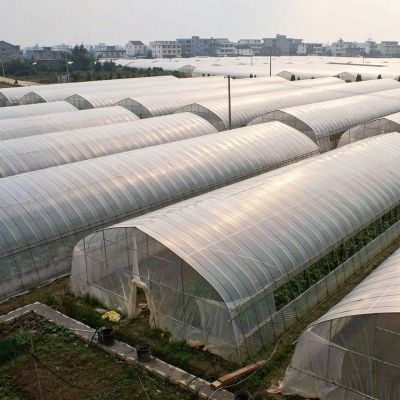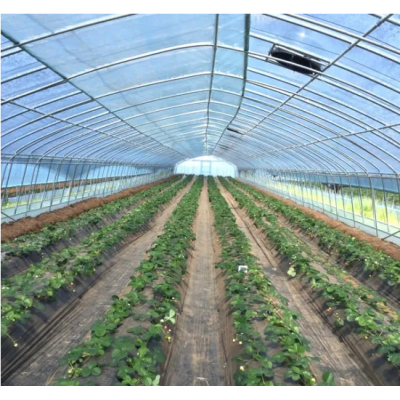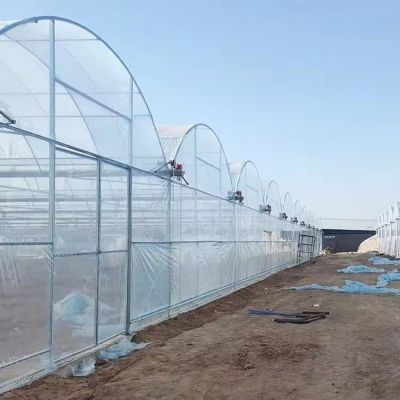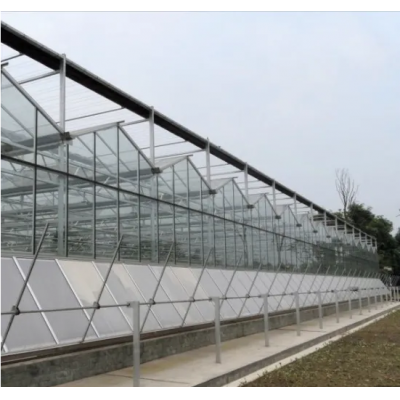
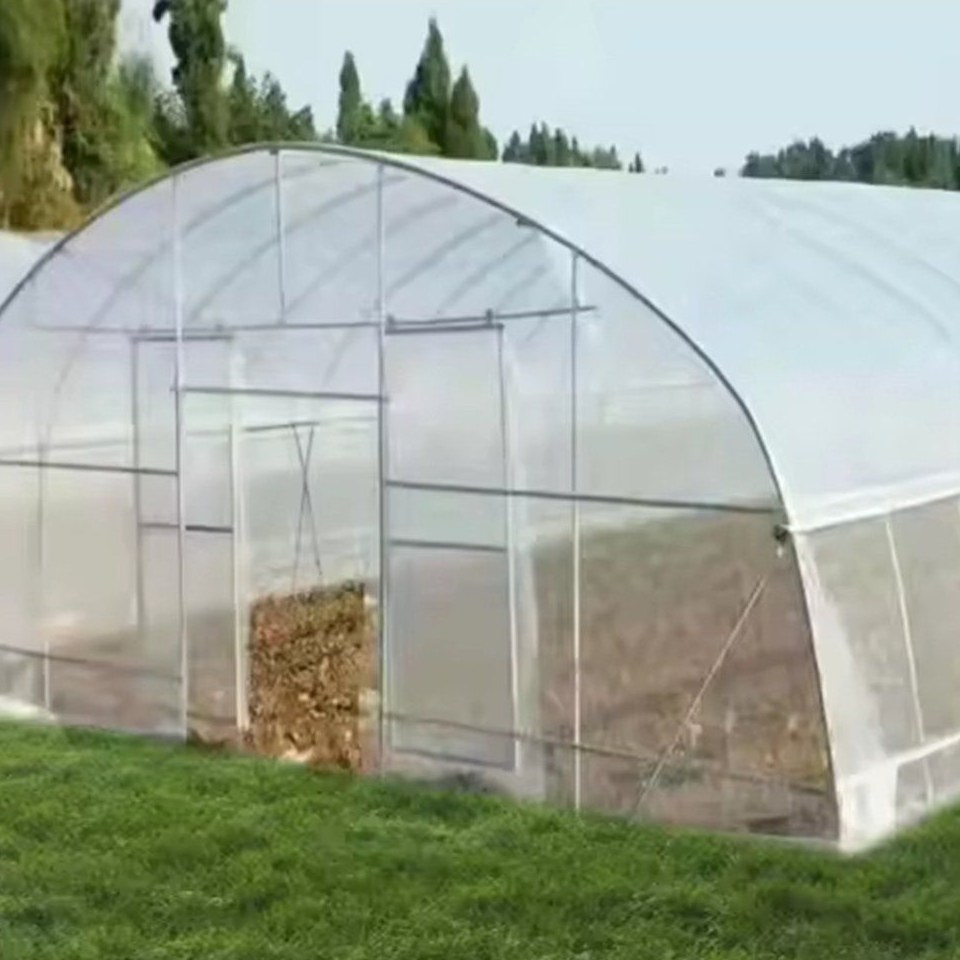
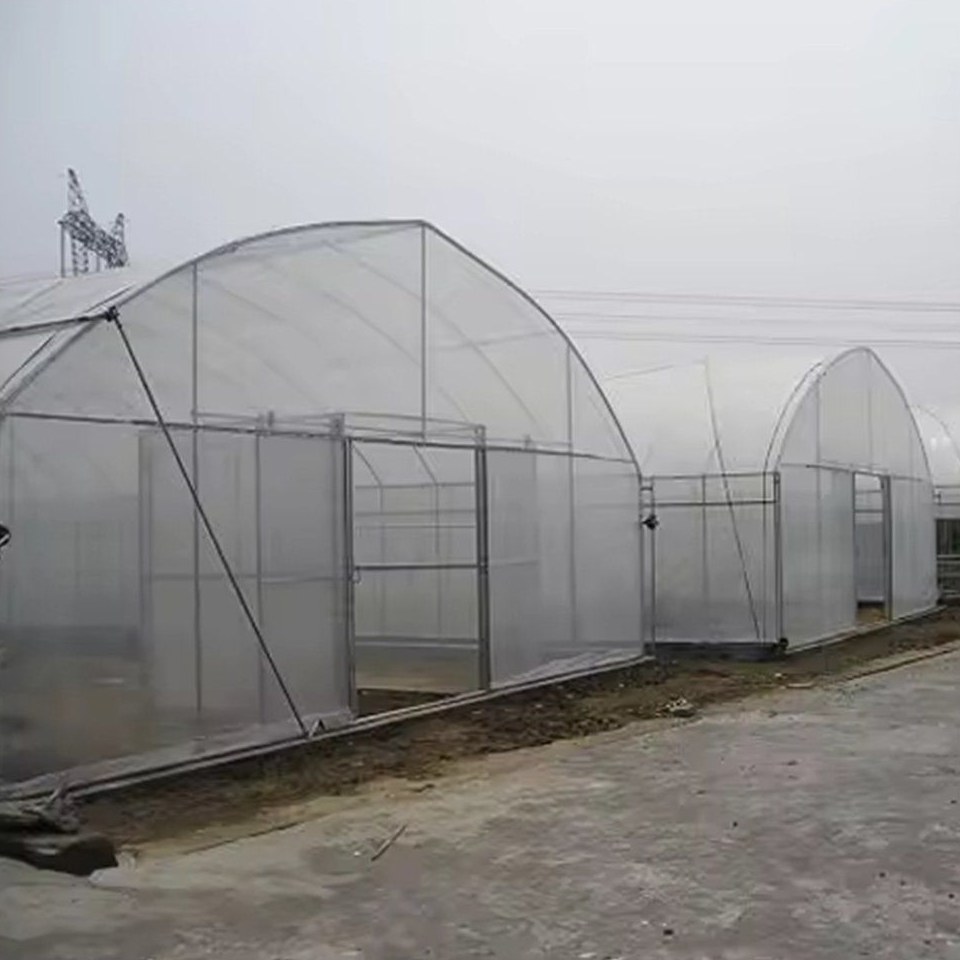
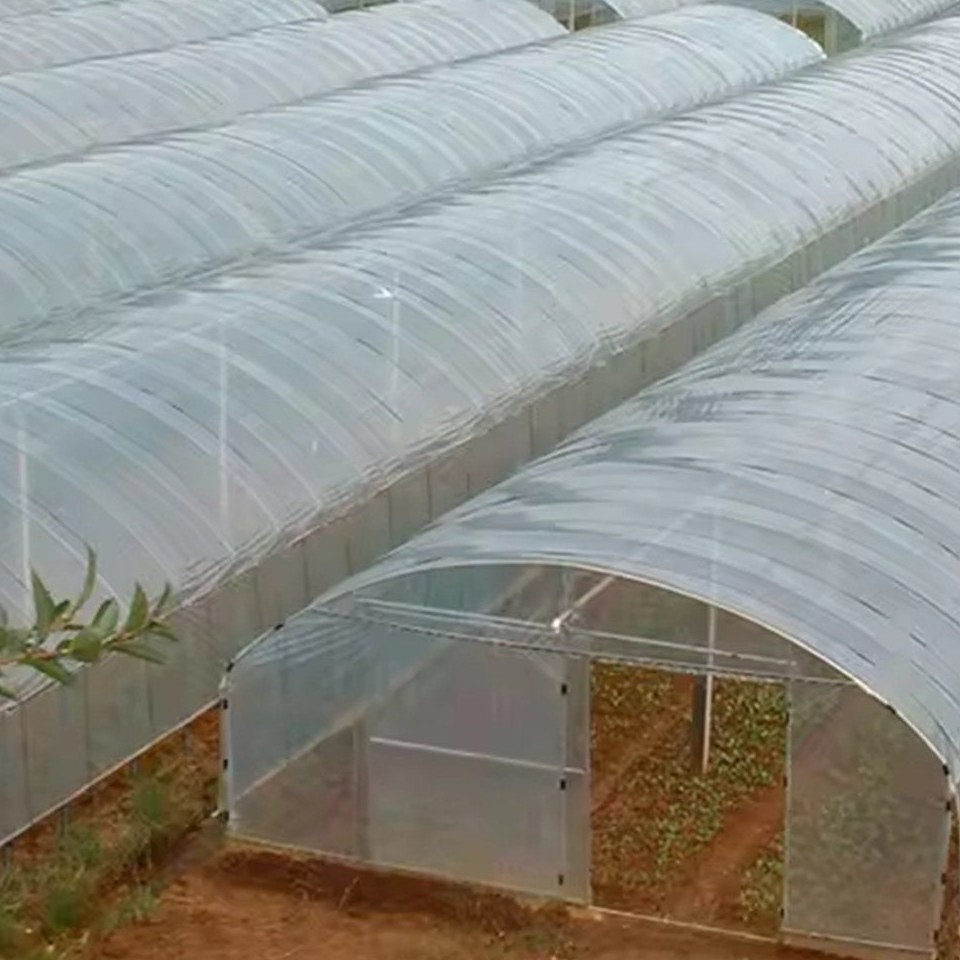
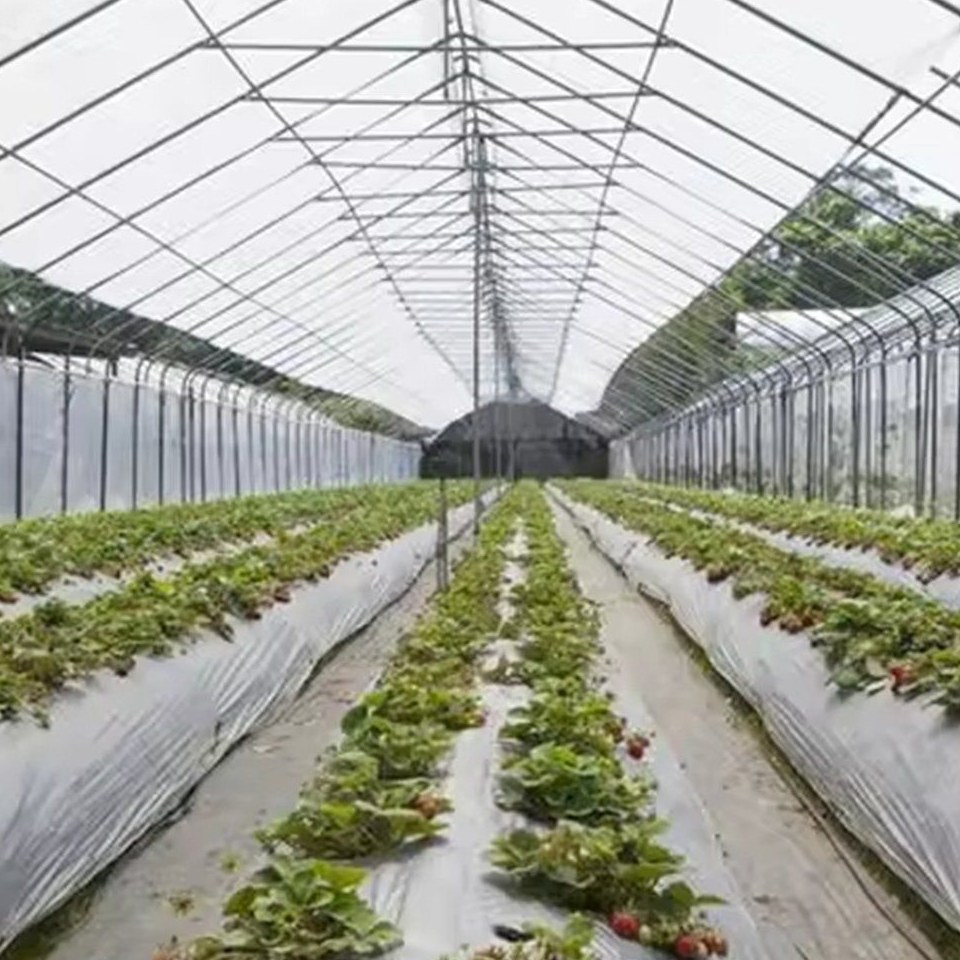
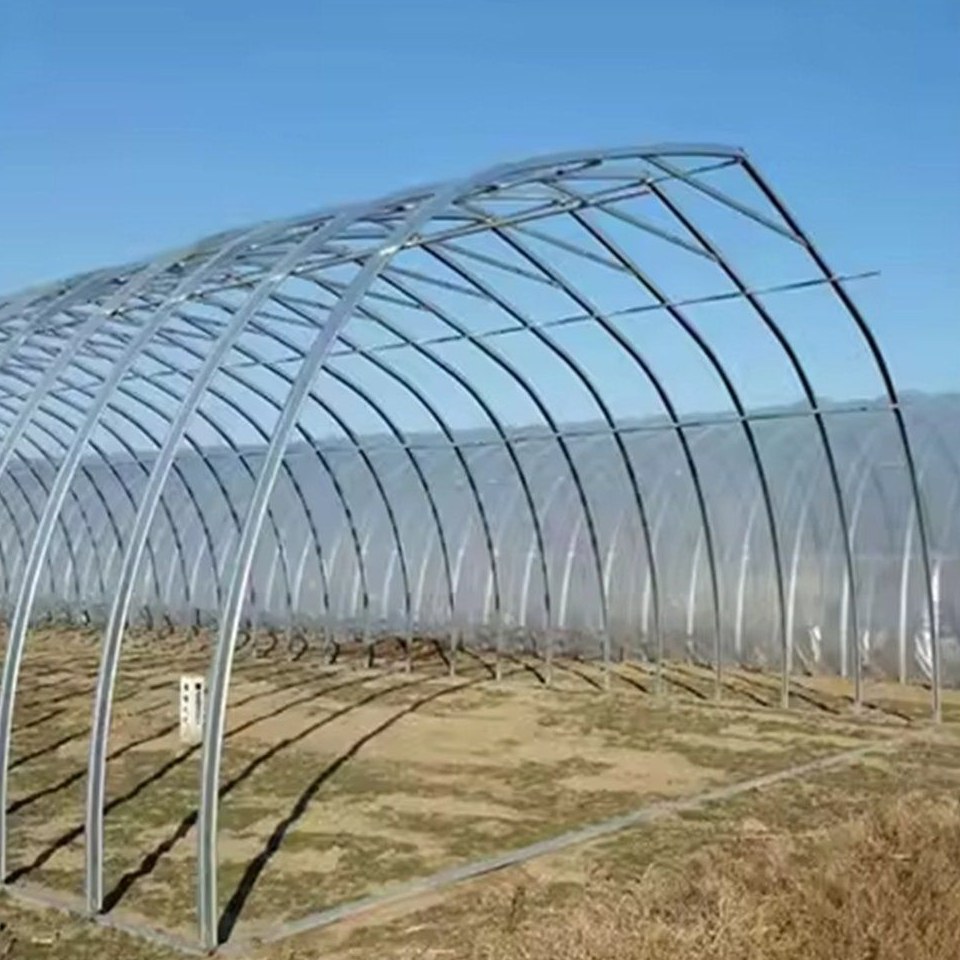
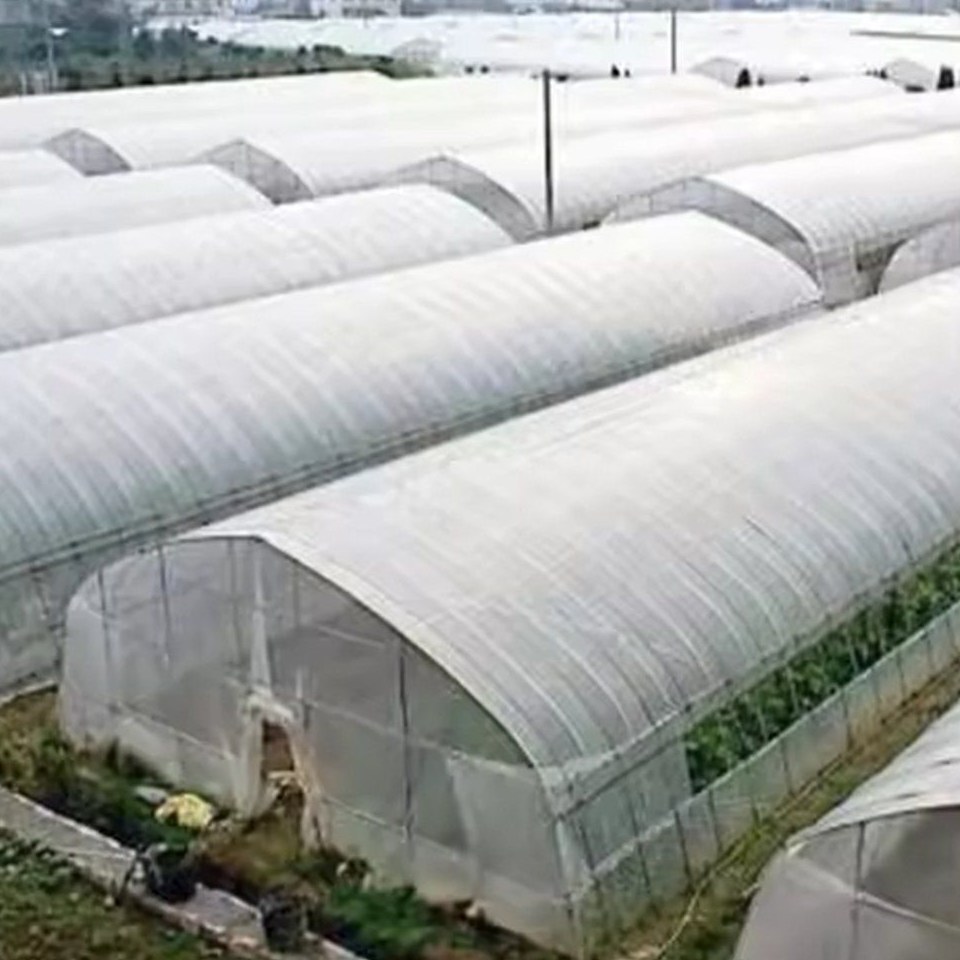
The house is a single arch tunnel on hot dip galvanized steel hoops with a 275 g/m2 zinc coating, which is the number that decides how long the frame survives condensation running down it every morning. Hoops are supplied pre formed and drilled, ground posts are driven rather than set in concrete, and the film goes on over the top with clips. Roll up sidewalls run both long walls and end vents are fitted into the gables, so the house exchanges air at crop level as well as at the ridge. Cover film is PEP at 100, 150, 200 or 250 micron. Arch tube runs from 25 mm to 60 mm according to span.
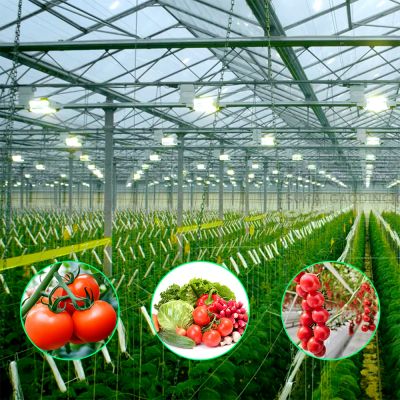
A tomato crop only needs four things from a tunnel: height over the row, air at the height of the leaves, water at the root, and a roof that does not need repairing in the middle of the season. Everything else in the specification is there to deliver those four at a cost the crop can carry, which is why the practical decisions on a tunnel are the base, the coating and the openings rather than the size.
A tunnel is a light structure carrying a light load, so a full concrete base is usually money spent on a foundation the frame does not need. Driving ground posts to depth and bolting the hoop ends to them carries the wind uplift instead, and it removes the curing time from the programme: the house can be raised as soon as the posts are in, rather than waiting on concrete before the hoops can go up.
It also keeps the house relocatable in principle, because there is no slab to abandon. Where a site does need a base rail or a cast foundation, the hoops are fixed to it the same way, so the decision is a site decision rather than a frame decision. The wider tunnel family is listed on the tunnel greenhouse range page on this site.
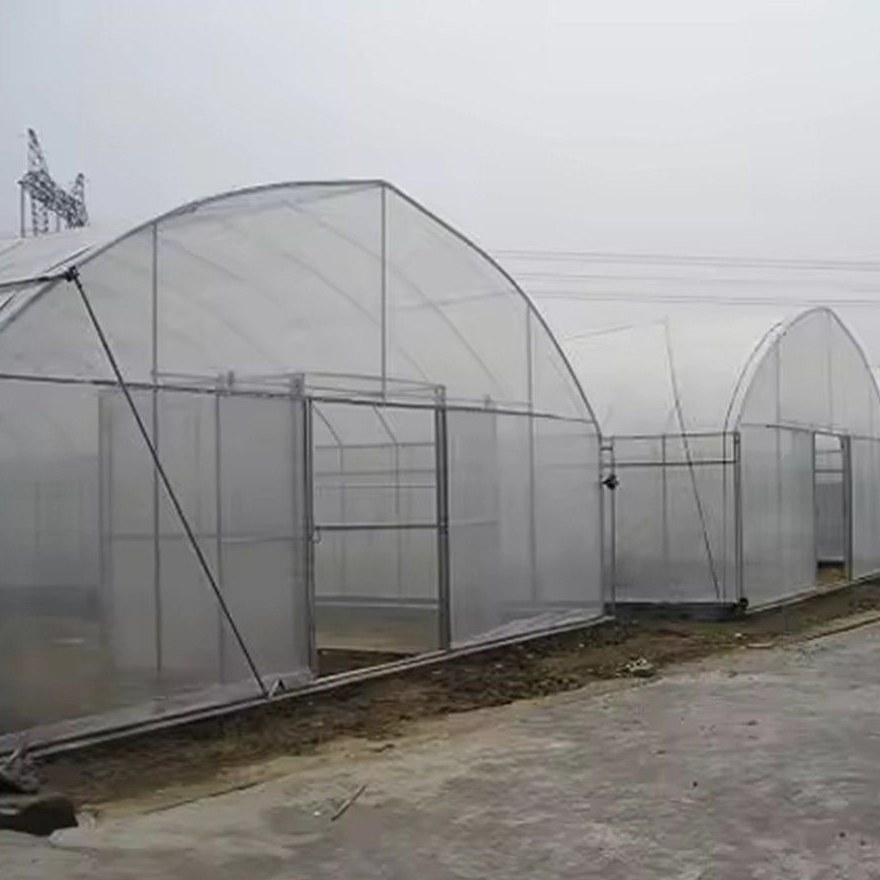
The hoops are hot dip galvanized steel pipe at a 275 g/m2 zinc coating. The coating weight is the specification that matters, because the failure mode on a tunnel is not structural: it is rust starting at the base where the hoop meets wet soil, and at any drilled or cut point that was not coated. Hot dipping after forming means the zinc reaches the bore, the cut ends and the wall of each hole.
Arch tube is supplied in 25, 32, 40, 50 and 60 mm diameters, so a wide or exposed site gets a heavier section rather than the same tube as a sheltered one. The hoops are tied with purlins and the joints are bolted with the fittings supplied. A taller tunnel on the same principle is described in the high tunnel greenhouse for taller crops.
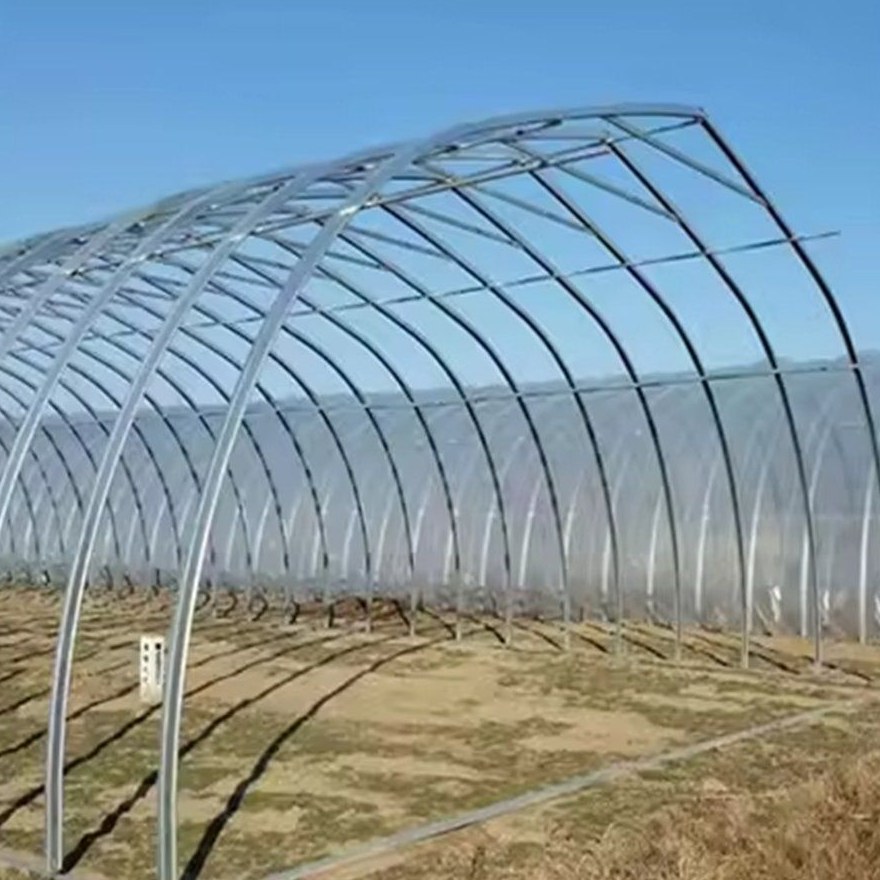
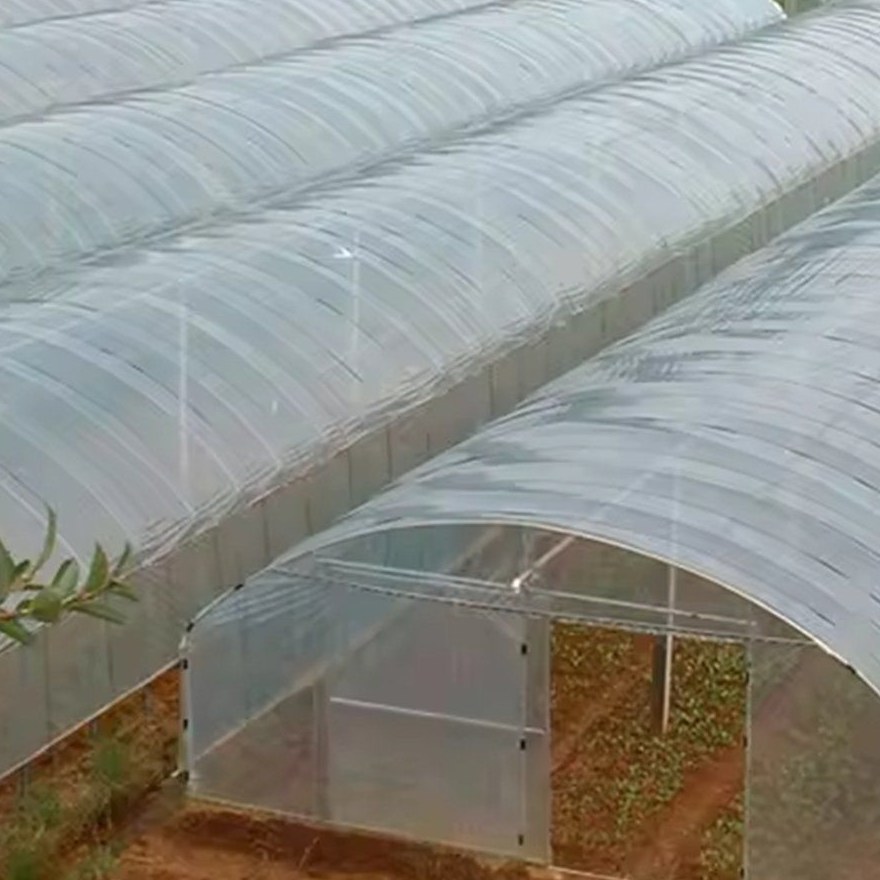
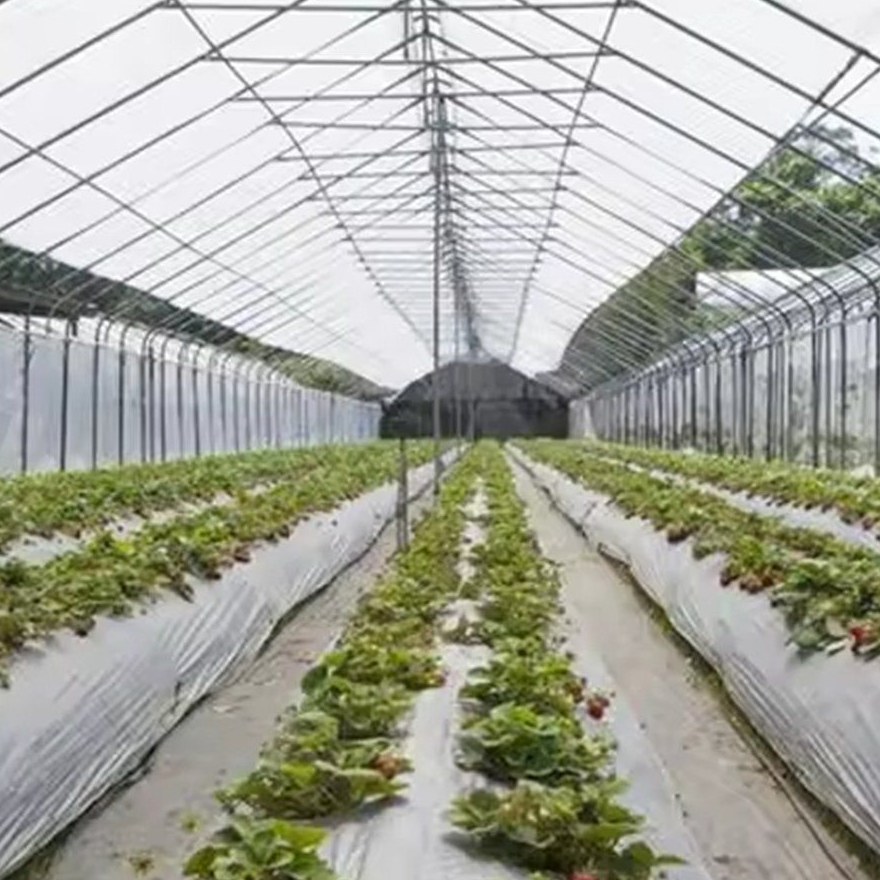
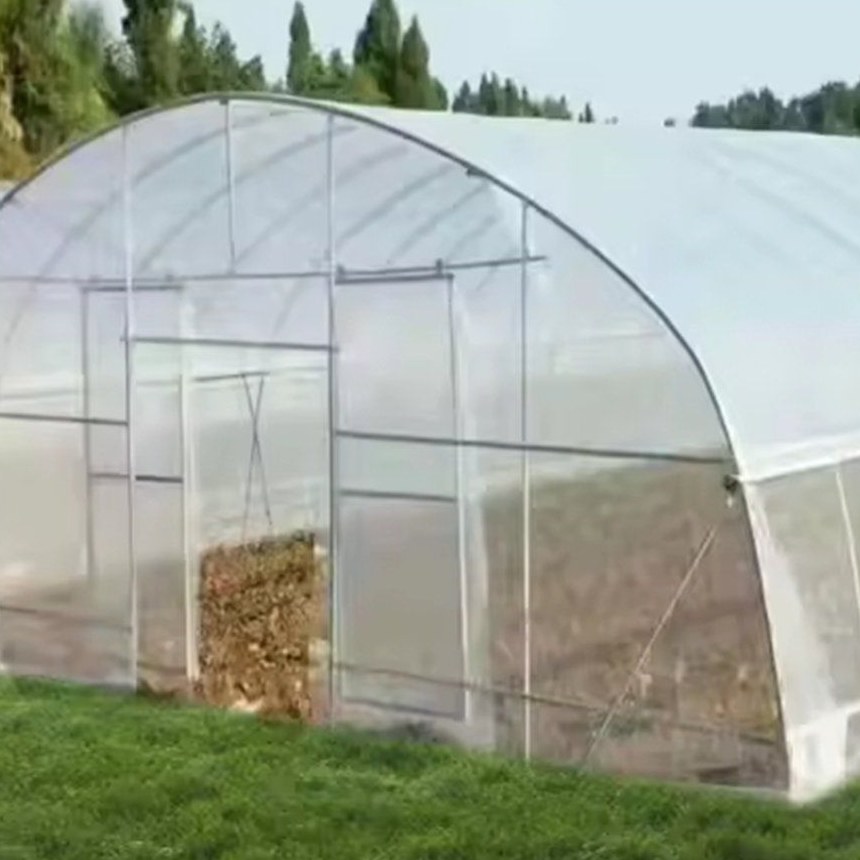
The cover is PEP film at 100, 150, 200 or 250 micron, held to the hoops with clips along the base rail and the purlins. Roll up sidewalls run the length of both long walls and end vents are fitted into the gables, so the ridge and the canopy layer are both exchanged rather than one at a time. On a tomato crop that matters most in the late afternoon, when the canopy has to dry before the temperature drops, and an opening at leaf level is what does that.
Heating, cooling, shading and drip or micro irrigation can all be added on the same order, and the side and top ventilation can be specified separately where a site has one prevailing direction. A tunnel supplied with film cover and shade net over the same frame is described in the single span tunnel house with film cover and shade net.
The table below is the standard build. Span, length, height, cover and ventilation are set to the site and to the crop.
| Greenhouse span | 8 m / 9 m / 10 m / 11 m / 12 m |
| Greenhouse length | 10 m to 100 m, or built to client demand |
| Greenhouse height | 3 m to 8 m |
| Frame | Hot galvanized steel pipe, 275 g/m2 zinc coating |
| Arch tube diameters | 25 mm / 32 mm / 40 mm / 50 mm / 60 mm |
| Cover material | PEP film, 100 / 150 / 200 / 250 micron |
| Ventilation | Roll up sidewalls on both walls, end wall vents |
| Foundation | Driven ground posts, no concrete required |
| Wind load | 60 km/h to 130 km/h |
| Snow load | 0.25 kN/m2 to 0.5 kN/m2 |
| Rainfall | 140 mm3/h |
| Options | Side or top ventilation, heating, cooling, shading, drip and micro irrigation |
| Crops | Tomato, pepper, cucumber, leafy vegetables and cut flowers |
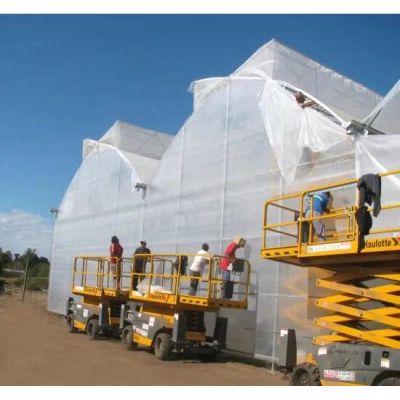
The kit arrives pre formed and drilled with the fittings, so the work on site is raising and tensioning rather than fabrication. Ground posts are driven to the drawing first, the hoops are bolted onto them and tied with purlins, and the film is pulled over last. Because there is no concrete to cure, a tunnel of this type is normally standing within a few days of the posts going in, and no welding is done on the frame at any point.
Maintenance is short and it is mostly visual. The item worth checking every season is the base, where the hoop meets wet soil, because that is where a coating failure shows first. After that: film tension along the base rail and the purlins, the sidewall rack and the vent gear before the season turns, and the drainage outside the wall so water does not stand against the posts.
Tunnels of this type are used for tomato, pepper and cucumber production, for leafy vegetables and herbs, for soft fruit and for cut flowers. They suit growers bringing a field crop under cover for the first time, operations that want the house raised by their own team without a concrete contract, and sites that may need to move or extend the structure later.
Research and extension material on protected crop production, including work on the growing environment and on crop quality under cover, is published by Cornell University through its horticulture section. Commercial growing practice and market reporting for the protected cropping sector is published by GrowerTalks. The question that decides the specification is normally the crop the house will be running in ten years, not only at handover.
No. The hoops are bolted to ground posts driven to depth, which carries the wind uplift and removes the curing time from the programme. Where a site needs a base rail or a cast foundation, the hoops fix to it the same way, so the choice is made for the ground rather than for the frame.
It is the mass of zinc applied per square metre of steel, in this case 275 g/m2. It is the number that governs how long the frame resists corrosion, and on a tunnel the critical point is the base where the hoop meets wet soil. A heavier coating buys time at exactly that point.
The galvanized steel frame is rated for 15 to 20 years under normal growing conditions. The film cover runs on a shorter cycle than the frame, typically 3 to 5 years depending on UV exposure at the site.
We provide a 10 year structural warranty and a 5 year anti-corrosion warranty on the galvanized frame. Details are set out in the contract for each project.
Send your site dimensions, the crops you plan to grow and your local wind and snow loads. We reply with a layout drawing and a full quotation.