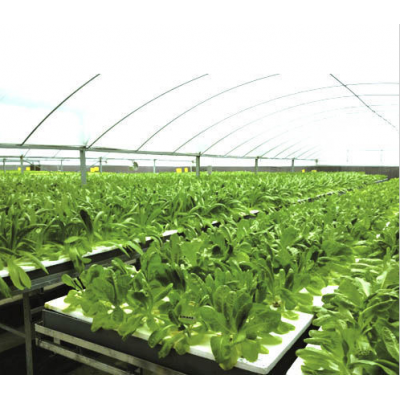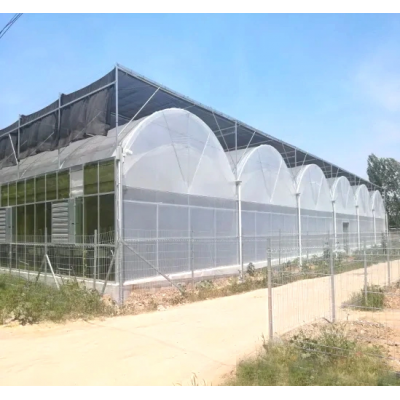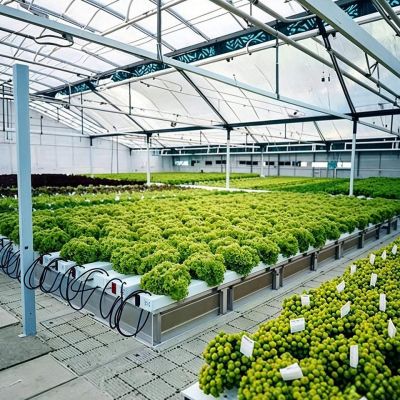


A mobile rack system is a way of taking the aisles out of a greenhouse. Instead of leaving a fixed walkway between every bed, each rack carries its crop on channels and moves on casters with lockable brakes, so the walkway is opened where the work is happening and closed again when the racks are parked. Each cart measures 180 cm by 60 cm and carries sixteen growing channels fed by drip irrigation. The frames ship flat packed with pre drilled holes, so the house can be closed and the growing layout set out afterwards.
Fixed aisles are the part of a greenhouse that earns nothing. A mobile rack system takes them out. The racks carry the crop and move on casters, so the walkway is opened where the work is happening and closed again once the racks are parked. What is left is more growing area on the same floor, in a house that does not have to be rebuilt to get it.
A bed layout fixes the walkway for the life of the house. Every bed needs a route to it, and those routes stay empty whether or not anyone is using them. On casters with lockable brakes, the route is only opened when it is needed. The racks are pushed apart to work a row and closed back together afterwards, and the brakes hold the rack where it was put instead of letting it drift under a hose or a trolley.
On the layout published for this build, thirty racks fit into 100 square metres. That is the point of the arrangement. The same floor carries more crop, and the packing station is reached by rolling the rack to it rather than carrying the harvest across the house. Racks of this family sit with the rest of the hydroponics system range on this site.

The support pipes are galvanized steel and the growing channels are white food grade PVC, 1.8 mm to 2.0 mm thick, supplied in 2.9 m and 5.8 m lengths or cut to order. Channels can be set as one flat layer or stacked in several layers, and a cart runs to a 180 cm by 60 cm footprint carrying sixteen channels.
The frames arrive flat packed with the holes already drilled. That suits a site where the house is finished before the growing equipment is set out, because the work on site is bolting and levelling rather than cutting and marking. Extra layers are added to the same cart rather than to a second cart, so a house can be brought up to full density in stages as the crop plan fills out.

Each channel is fed by drip irrigation, so the solution reaches the root instead of flooding across the tray. The build is made for soilless planting and can be run as deep water culture or as part of an aquaponic loop, which suits a grower already working with fish tanks or with a recirculating feed.
Because the rack moves, the feed has to move with it. The run is taken in flexible hose on a loop that follows the cart, so a rack can be rolled out and worked without breaking the line. A fixed raised layout that does the same job of bringing the crop up to working height is described in the multi layer growing bench.

The table below is the standard build. Cart count, layer arrangement and the control package are set to the house and to the crop.
| Support pipes | Galvanized steel pipes |
| Growing channel material | Food grade PVC |
| Channel thickness | 1.8 mm to 2.0 mm |
| Channel length | 2.9 m, 5.8 m or cut to order |
| Channel colour | White |
| Layer arrangement | One flat layer or multiple layers |
| Cart footprint | 180 cm by 60 cm |
| Channels per cart | 16 |
| Load per cart | 40 kg of fruit per cycle |
| Planting type | Soilless |
| Irrigation | Drip irrigation, deep water culture or aquaponic loop |
| Mobility | Caster wheels with lockable brakes |
| Crops | Tomato, cucumber, leafy vegetables, herbs, flowers and microgreens |
| Layout | Up to 30 racks per 100 square metres |
| Customisation | Cart count, layer arrangement and control package set to the site |

The order arrives as formed and drilled steelwork with the channels and the drip set. The floor is levelled or a base rail is set to the drawing first, because a rolling rack needs a flat run. The frames are bolted up, the casters and brakes are set, the channels go in and the drip line is connected to the header. On a multi layer cart the upper layers are fitted after the frame has been levelled.
Routine work divides into three parts. Casters, brakes and the bolted joints are checked on a schedule, because a rack that has to be pushed is a rack that wears. Channels and filters are washed between crops so root material does not carry over, and the pump, the dosing gear and the return are serviced on the same cycle as the crop. Where the house also carries a cover, that side is kept on its own schedule.

Racks of this type are used for tomato and cucumber production where the crop is trained up and picked over several passes, for leafy vegetables, herbs and microgreens on a short cycle, and for flowers grown to a controlled schedule. They suit operations that want more crop on the floor they already have, houses laid out around a central packing line, and growers who want to add layers to a cart later rather than buy a second house.
Research and extension material on controlled environment growing, including work on soilless and water based production, is published by the Controlled Environment Agriculture Center at the University of Arizona. Production and market reporting for growers of protected crops is published by HortiDaily. A house run on drip feed without the moving rack is described in the hydroponic drip irrigation system.

Because a fixed bench needs a walkway next to it for the life of the house, and that walkway is only used when someone is working there. On casters the same rack opens the route when the row is being worked and closes it afterwards, so the floor that would have been aisle carries crop instead.
Lockable brakes on the casters. The rack is pushed into position and the brakes are set before anyone reaches into the crop, so the cart stays where it was put rather than shifting under a hose or a trolley.
The steel frame is rated for 15 to 20 years under normal growing conditions. The casters, the drip line and the pump and dosing gear run on their own service cycles and are replaced as they come due.
We provide a 10 year structural warranty and a 5 year anti-corrosion warranty on the galvanized steelwork. Details are set out in the contract for each project.
Send your house dimensions, the crop you plan to run and the growing layout you intend to use. We reply with a layout drawing and a full quotation.