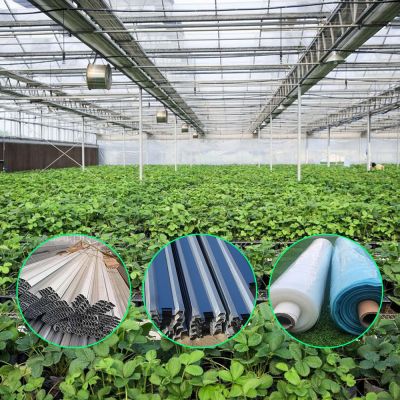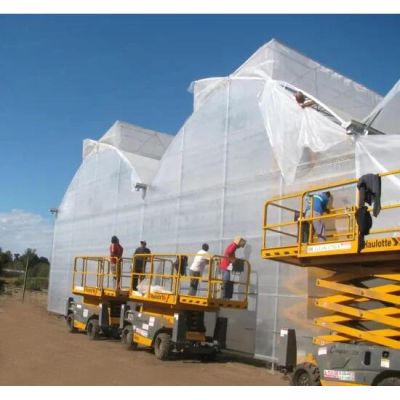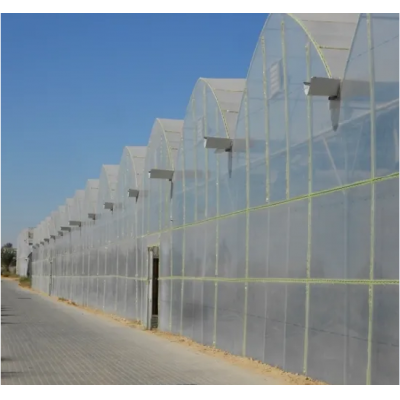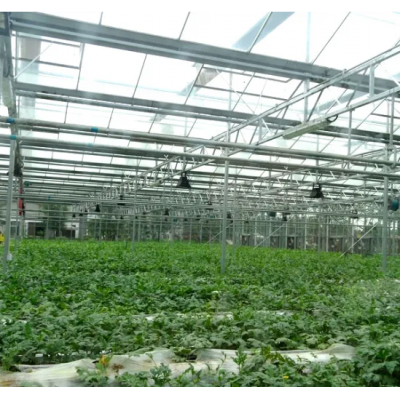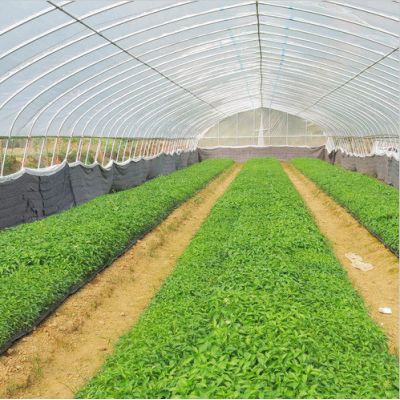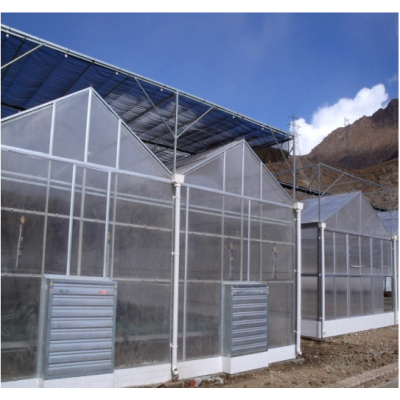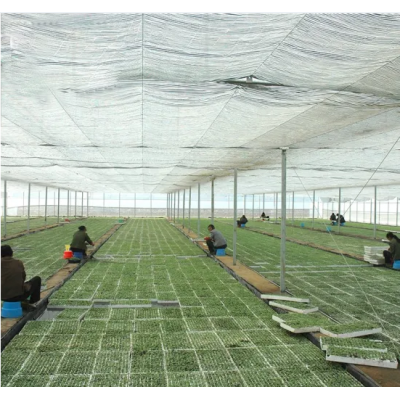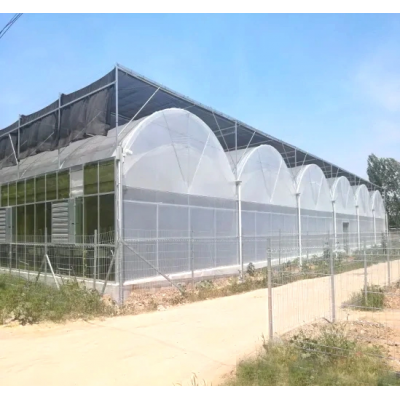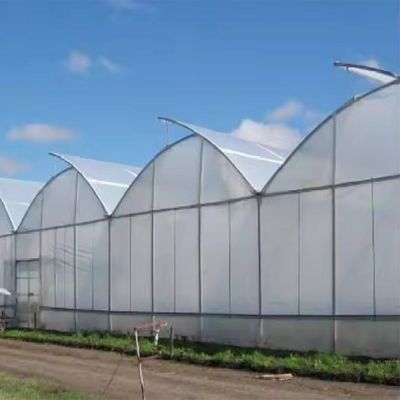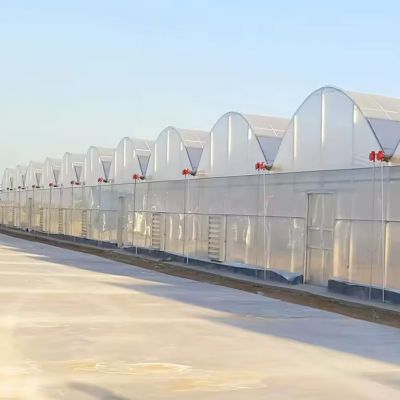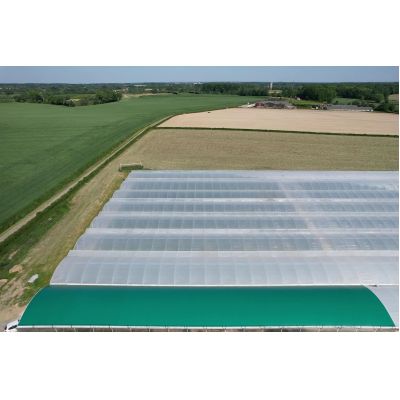


Polyethylene film is the most widely used greenhouse covering in the world: it costs little, it comes in large sheets, it is quick to attach, and it transmits light well. This multi-span house puts that covering on a structure built for commercial output - a hot-dip galvanized steel frame with a zinc coating of 200 to 275 g/m2, covered with 150-micron UV-resistant anti-drip film. Bays are joined at the gutter so the interior stays clear for mechanised work, and the structure is braced for the wind and snow loads of the site. Dimensions are set from the crop and the layout, and the frame assembles with modular fittings rather than welding, so it can be extended or relocated later.
A commercial multi-span polyethylene film greenhouse is the workhorse of large-scale protected production, and it is worth being clear about why. Film costs little, it arrives in wide sheets, it can be replaced without touching the steel, and it passes daylight well. Put that covering on a frame built for load and drainage and the result is a house that carries a real crop at a cost a farm can justify.
The frame is hot-dip galvanized steel with a zinc coating of 200 to 275 g/m2, which is what keeps the structure serviceable in a house that is damp for much of the year. The covering is 150-micron polyethylene with a UV stabiliser and an anti-drip additive: the stabiliser keeps the sheet from embrittling in its first season, and the anti-drip additive stops condensation forming beads that fall onto the canopy. The house is braced for the wind and snow loads of the site, and the rated loads are stated with the quotation.

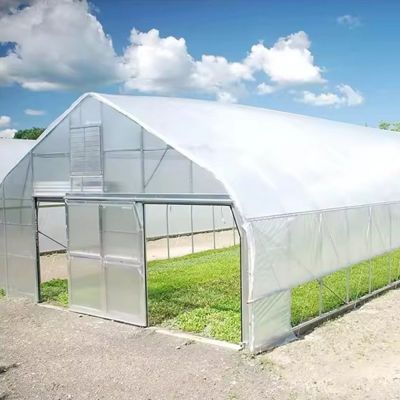
Joining bays at the gutter removes the end walls and the strips of ground that separate individual tunnels, so the covered floor is growing space and the interior stays clear enough for machinery to work in. Planting, maintenance and harvesting all move down clean aisles instead of around structures. That is the practical difference between a house that scales and one that has to be duplicated across a field - growers stepping up from a single arch normally start with the single span tunnel house and move to this form when the labour inside the house becomes the constraint.

The structure assembles with modular fittings and no site welding, which keeps the zinc coating intact at every joint and means the house can be extended in bays or taken down and re-erected if the farm layout changes. Re-covering is a separate job from the frame: the film is renewed every few years while the steel stays in service, and a covering chosen for your light levels today can be changed when the crop changes. Covering thickness, layer count and span are all set at order stage - the PE film greenhouse spans we build run from 8 to 20 metres, and the basic kit version of the same idea is covered by the complete greenhouse kit.

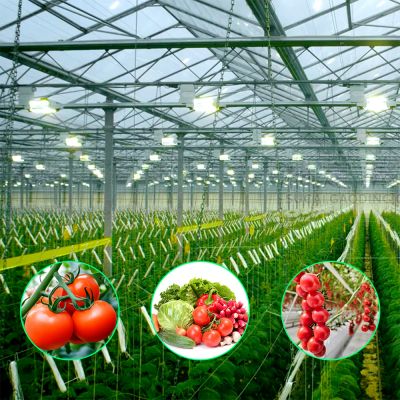
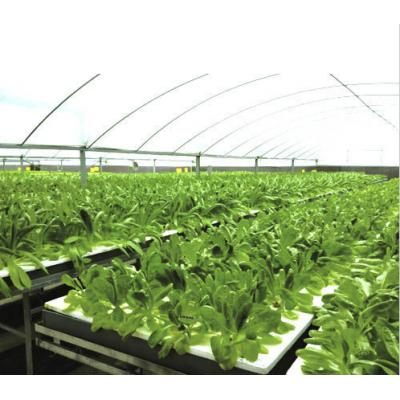
These houses carry tomatoes, peppers and chillies, strawberries, leafy vegetables and flower or nursery stock. Compared with a glass house, a double-layer film house uses less heating energy and the covering weighs a fraction of glass, so the supporting structure can be lighter for the same covered area - which is why film multi-span houses dominate commercial vegetable production in cost-sensitive markets. As a factory-direct manufacturer we supply across North America, Europe, Southeast Asia and Africa. Structures are crated to keep container volume low and the loading date is confirmed in writing. Standards for greenhouse structures are published by USDA, and commercial protected cropping is covered by HortiDaily.

Film costs less, arrives in large sheets, is quick to attach and transmits daylight well, and it can be renewed without touching the steel frame. A double-layer film house also uses less heating energy than single-pane glass glazing, and the covering weighs far less, so the structure can be lighter for the same covered area.
Yes. The frame assembles with modular fittings and no site welding, so bays can be added as the operation grows and the structure can be dismantled and re-erected if the farm layout changes. Keeping welding off site also means every joint keeps its galvanized coating.
The hot-dip galvanized steel frame is designed for a 15-20 year service life in normal agricultural environments, with a double-sided zinc coating of 200-275 g/m². Film covers are replaced every 3-5 years, while glass and PC panels carry their own manufacturer warranties.
The hot-dip galvanized steel frame carries a 10-year structural warranty covering structural safety, plus a 5-year warranty against corrosion perforation. It is designed for a 15-20 year service life, and the covering film carries a 3-5 year UV warranty depending on material type.
Send your growing area, the crops and the number of houses you need, your location and the local wind and snow conditions. With that we can set the span, the covering specification and the fit-out, and return a quotation with a structure drawing and a bill of materials.