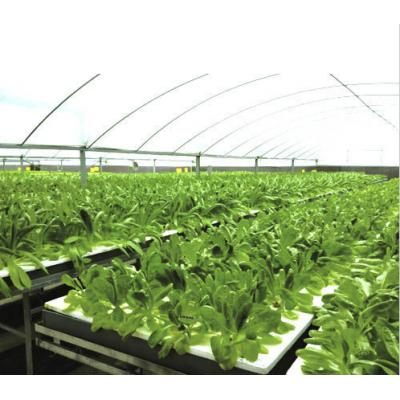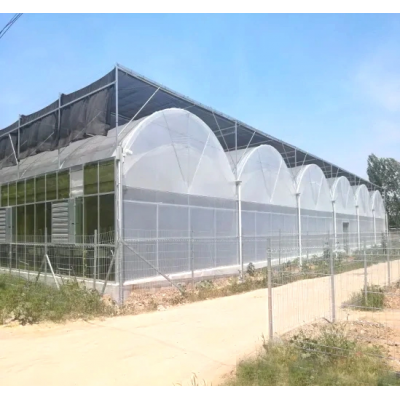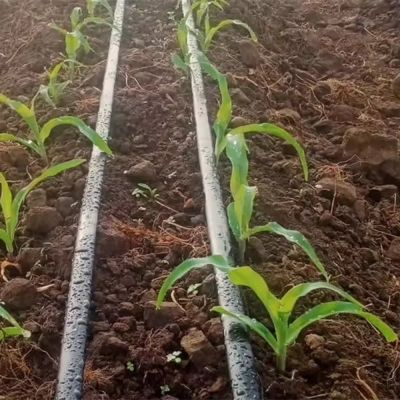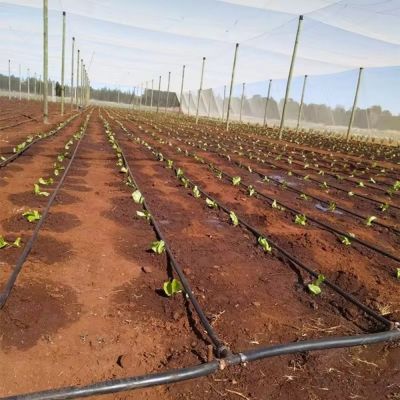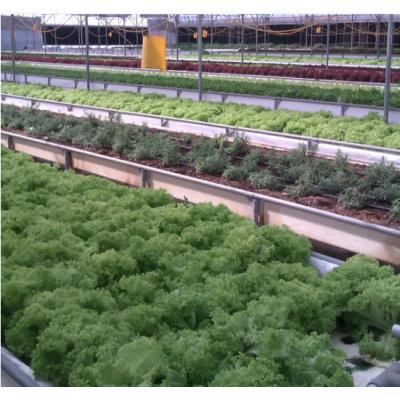


Dripping irrigation equipment for agricultural greenhouse production. A tank and pump feed main and branch lines, and every plant receives water and nutrients through its own emitter. Filtration keeps the line clear, valves allow bays to be watered independently, and the kit suits both soil and substrate growing.
Dripping irrigation puts water where the roots are instead of over the whole bed. In an agricultural greenhouse that means less water used, less weed growth between the rows, and a crop that dries off quickly after feeding rather than sitting wet. It also makes the water and nutrient supply something you control, rather than something the weather decides.

The package includes the water or nutrient tank, pump, filtration, main line, branch lines along each row, drip line or emitters, and the valves that let you isolate a bay. Pressure-compensating emitters are used where rows are long so delivery stays even from the first plant to the last, and a filter is fitted ahead of the emitters to keep them from blocking.
Watering is set by timer or controller, with cycle length and frequency matched to the crop and the season. Where nutrients are injected, the dosing point sits after the filter so the solution reaches every plant evenly. For crops grown in soil the same layout applies with emitters spaced along the planting row; for pot and bag culture the dripper sits at each container.
The kit arrives with a layout drawing and a bill of materials, and is assembled with standard fittings rather than specialist tools. The routine is simple: check tank level and pump daily, flush filters on a schedule, walk the rows to confirm emitters are running, and clean or replace any dripper whose flow has dropped. Growers looking at soilless growing can compare our drip irrigation system, and greenhouse watering layouts are covered under irrigation. USDA publishes guidance on irrigation practice, and HortiDaily covers greenhouse growing worldwide.
Tank, pump, filtration, main line, branch lines, drip line or emitters and isolation valves, plus a layout drawing and bill of materials. The kit is assembled with standard fittings and can be supplied for a new greenhouse or retrofitted into an existing one.
Yes. In soil, emitters are spaced along the planting row. For pot and bag culture a dripper is placed at each container. Where nutrients are injected, the dosing point sits after the filter so the solution reaches every plant evenly.
The hot-dip galvanized steel frame is designed for a 15-20 year service life in normal agricultural environments, with a double-sided zinc coating of 200-275 g/m². Film covers are replaced every 3-5 years, while glass and PC panels carry their own manufacturer warranties.
The hot-dip galvanized steel frame carries a 10-year structural warranty covering structural safety, plus a 5-year warranty against corrosion perforation. It is designed for a 15-20 year service life.
Send your growing area, crop type and local climate. If you already have a layout drawing, that is enough to start. Our engineers then return a quotation with a system layout and a bill of materials.