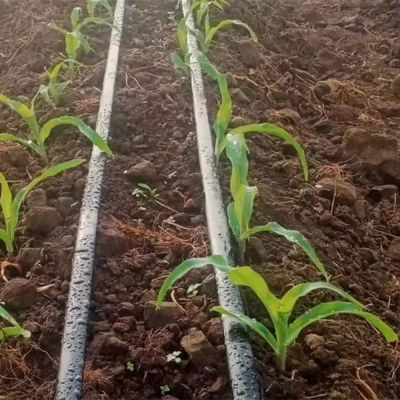


Drip tape is the least costly way to put water at the root rather than over the field. It is a thin walled tube with emitters built in at a fixed spacing, supplied on reels and laid along the row, so the whole field is watered from the same line at the same rate. Wall thickness and emitter spacing are what decide how long a reel survives, and both are set on the order against the crop and the soil. Reels are supplied in 1000 metre lengths for field laying.
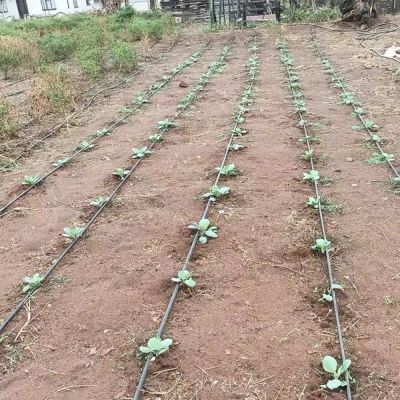
A drip line places water at the plant rather than across the field. On an open row crop that is the whole argument for laying tape: the water that is not delivered to the root is water that evaporates, runs off or feeds a weed, and a tape line is the least expensive way of getting the delivery point right.
It is a thin walled flexible tube with emitters formed into the wall at a fixed spacing. It issupplied on reels, unrolled along the row and connected to a sub main at one end, so a hectare iscovered by a set of lines rather than by a network of rigid pipe. The 2000 metre quantity is sizedagainst a hectare at normal row spacing.
Because the wall is thin, the tape follows the ground. On a field that is not laser levelled itbends around the curves and follows the fall rather than sitting at one height, which is what stops thelow corner of a block from being the only part that gets water. Lines of this type sit with the rest ofthe irrigation system range on this site.

The emitters run at 2 litres per hour and are set 30 centimetres apart along the tape. The spacingis the figure that decides whether the wetted band is continuous: on a close spacing the water fromadjacent emitters merges into a single band along the row, and on a wide one the crop sees separate wetspots with dry ground between them.
Flow rate and spacing are both set on the order, because they follow the crop and the soil ratherthan the tape. A sandy soil spreads water sideways far less than a clay one does, so the same spacingthat works on one field leaves dry shoulders on the next. That is a quotation stage decision, and it isthe reason the same tape is supplied in several configurations.

The material is UV stabilised and runs for about three seasons. Wall thickness is what decideswhether that is one crop or several: a thin wall costs less per metre and is normally lifted at the endof a season, while a thicker one is left in place and used again. Both are supplied on the same reels.
The tape is bought by the reel rather than by the metre, and the reels are packed into cartons forshipment. Filtration ahead of the tape is part of the same specification, because the emitter passageis small and a partly blocked filter shows up as a short line at the far end of the block.

| Function | Drip irrigation |
| Product | Built in drip irrigation tape |
| Tape size | 16 mm |
| Quantity | 2000 m, sized for one hectare |
| Emitter flow | 2 L/h per emitter |
| Emitter spacing | 30 cm |
| Material | UV stabilised, about three seasons of service |
| Packing | Reels of 1000 m in cartons |
| Application | Agricultural irrigation, open field and row crops |
| Customisation | Emitter spacing, wall thickness and flow rate set on the order |

The sub main goes in first and the tape is unrolled along the row and connected, with the endsclosed off. Lines are laid with the emitters facing up, which keeps them from being pressed into thesoil, and the run is flushed before the crop is planted so any debris from the installation leaves theline before the emitters are working against a root. Filters are fitted ahead of the block.
Maintenance is the filters and the flush. The filter is cleaned on a short cycle, because theemitter passage is small and a partly blocked filter shortens the line at the far end of the blockfirst. Lines are flushed at the start and end of each season, and on a tape that is being lifted it isrolled up and stored out of the sun rather than left on the ground.

Tape of this type is used for open field vegetable and row crop irrigation, for orchards andvineyards where the line runs along the tree row, and for any block where the water supply is meteredor limited. It suits a grower moving from furrow or overhead irrigation, an operation laying out ahectare block for the first time, and distributors holding tape in several wall thicknesses againstdifferent crop cycles. A one hectare kit built around the same tape is described in the one hectare drip irrigation kit page.
Research and extension material on horticulture and irrigation practice is published by Michigan State University Department of Horticulture. Farming and irrigation reporting for growers in South Asia is published by Agriculture India. A drip tape system sized for a larger block is described in the drip tape irrigation system for five hectares page.
Whether the wetted band is continuous. On a close spacing the water from adjacent emitters mergesinto one band along the row; on a wide one the crop sees separate wet spots with dry ground betweenthem.
The material is UV stabilised and runs for about three seasons. Wall thickness decides whether thatis one crop or several: a thin wall is normally lifted at the end of a season, and a thicker one isleft in place and used again.
The tape itself runs for about three seasons under normal field conditions. The filters, valves andthe sub main it connects to run on their own service cycles and are replaced as they come due.
We provide a 10 year structural warranty and a 5 year anti-corrosion warranty on the galvanized steelwork used in the supporting equipment. Details are set out in the contract for each project.
Send your block area, the crop you plan to run and your soil type. We reply with a layout drawing and a full quotation.