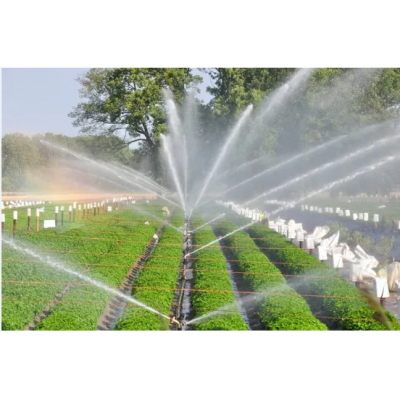


A micro sprinkler is the middle ground between a drip line and an impact sprinkler. It throws water over a small radius as a fine spray rather than placing it at a single point, so a row of bushes or a bed gets an even wetted band without the pressure loss a long drip run suffers. The head on this one rotates on a gear drive, which is what keeps the pattern the same over the whole circle instead of favouring one side, and the nozzles sit at a low angle so the root zone is wetted without soaking the foliage.
An impact sprinkler covers ground fast but throws water a long way, and on a bush crop that means a lot of it lands between the rows or on the leaf. A micro sprinkler works the other way round: a short radius, a fine pattern, and the water placed where the roots are. That is the reason it turns up on blueberry blocks and vegetable beds rather than on pasture.
The head delivers a fine spray at 20 litres per hour and rotates on a gear drive. A gear drive is what makes the pattern repeatable: the head turns at a fixed rate so every part of the circle gets the same dose, and the wetted band stays even as the run continues. On a berry row that is what stops one end of a block being ahead of the other.
Because the radius is short, the system is laid out as a line of heads along the row rather than as a few large sprinklers in the corners. That suits a bed or a bush row where the crop is in a defined band, and it also means a single blocked head shows up as a dry patch in one place rather than as a whole block going short. Systems of this family sit with the rest of the irrigation system range on this site.

A single head covers up to about 15 metres radius. Coverage is set by the nozzle and the working pressure rather than by the head alone, so the figure to design against is the spacing the heads are set at along the line, and that is chosen against the crop. Bulk orders are supplied with custom spacing from 3 to 6 metres and with stainless steel risers where the line is set high off the ground.
Risers are the part that decides how long the installation lasts. A sprinkler head sits in the weather and in the wet, so a riser that corrodes takes the head with it. Stainless steel is specified on the coastal and high humidity sites where a plated riser would not see out the season.

The nozzles sit at a low angle so the water reaches the root zone without crossing the foliage. On a fruit crop that matters because a wet canopy is where fungal pressure starts, and keeping the leaf dry removes the condition the disease needs rather than treating it afterwards.
The base is threaded to take a standard hose fitting, and the flow is adjustable between 5 and 30 litres per minute at the inlet. That range is what lets the same head be used on a small block off a domestic supply and on a commercial line off a pump, with the setting made on site rather than by changing parts.

The table below is the standard supply. Spacing, riser height and the nozzle set are chosen against the crop.
| Function | Micro spray irrigation |
| Type | Planter irrigation spikes with rotating heads |
| Flow per head | 20 L/h |
| Rotation | Gear driven, full circle |
| Coverage | Up to about 15 m radius |
| Nozzle angle | Low angle, wets the root zone below the canopy |
| Inlet | Threaded base for standard hose fittings |
| Adjustable flow | 5 to 30 L/min at the inlet |
| Spacing | Customizable from 3 m to 6 m |
| Risers | Stainless steel risers available |
| Crops | Blueberry and soft fruit, vegetables, flowers, nursery beds |
| Application | Farm, orchard and agricultural irrigation |
| Customisation | Spacing, riser height and nozzle set chosen to the site |

The sub main goes in first and the heads are set along it at the spacing the crop needs, with the riser height chosen so the head clears the canopy. On a sloping block the line is run along the contour rather than up it, because a head at the bottom of a fall sees more pressure than one at the top and the sprays stop matching. Filtration is fitted ahead of the heads, since a micro sprinkler nozzle is a small opening.
Maintenance is the nozzles and the rotation. A head that stops turning is usually grit in the drive rather than a worn unit, so the head is lifted, cleaned and refitted before anything is replaced. Nozzles are checked for wear at the start of each season, and on hard water sites they are descaled on a routine. The filters are cleaned on a short cycle, because a partly blocked filter drops the pressure at the far end of the line and the sprays go short there first.

Micro sprinklers are used on blueberry and soft fruit blocks, on vegetable and salad beds where the crop is in rows, and on nursery and flower beds that need an even wetted band without a wet canopy. They suit a grower moving off impact sprinklers to place water closer to the root, a block where the leaf has to stay dry for disease reasons, and sites where the supply is limited and the system has to be sized against it. A drip system for open field use is described in the drip tape irrigation kit page.
Research on protected horticulture and irrigation practice is published by Wageningen University and Research. Trade news covering horticulture and growing equipment is published by HortWeek. A combined irrigation and hydroponics system is described in the irrigation and hydroponics system page.

Because the water is spread over a band rather than placed at a point, which suits a bush or a bed where the roots spread. A drip line places water more precisely and uses less of it, and a micro sprinkler wets a wider root zone without needing a line per plant.
Because it decides whether the leaf gets wet. A low angle nozzle wets the root zone under the canopy and leaves the foliage dry, which is the condition a fungal problem needs removed rather than treated.
The heads and the stainless risers are expected to run for many seasons with routine cleaning, under normal agricultural conditions. Nozzles, filters and the hose connections are consumables and are replaced as they wear.
We provide a 10 year structural warranty and a 5 year anti-corrosion warranty on the galvanized steelwork used in the supporting structures. Details are set out in the contract for each project.
Send your block dimensions, the crop you plan to run and the spacing you intend to use. We reply with a layout drawing and a full quotation.