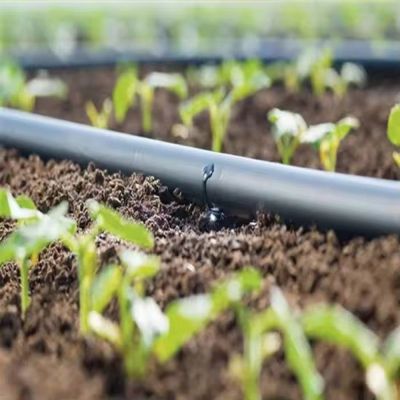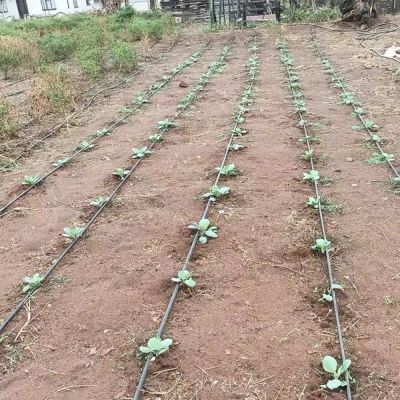


This is a drip tape irrigation kit for a five hectare block, built around a tape with the emitters formed into the wall so the line can be laid and lifted like a hose. A kit of this size is put together from the main hose, the tape, the fittings and the valves, so the block is watered from one control point rather than by moving equipment around the field. The tape delivers water at the root zone instead of over the canopy, which is where the saving on a commercial block comes from.
On a block of a few hectares the cost of watering is not the water, it is the labour and the pump hours. A drip tape layout changes both: the tape puts the water where the roots are instead of over the whole field, and once the kit is set out the block is run from valves rather than from someone moving equipment.
Tape is a thin walled line with the emitters formed into it during manufacture, which makes it a consumable rather than a permanent fitting. On a field crop that is the right trade: the tape can be laid along the beds for the season and lifted at the end of it, and the capital is in the main hose, the filters and the valves rather than in the lines under the ground.
The second reason is uniformity. Water delivered at the root zone reaches every plant on the row at the same rate, so a crop that is being fed through the same line takes up the same amount, and the wetter and drier patches of a block watered by hand stop appearing in the harvest. Irrigation and cooling equipment for a covered block are grouped on the irrigation system range page on this site.

A kit for a block this size is a set of parts rather than a single item. The main hose carries water along the headland, the tape is connected off it and laid along each row, and the filters, valves and fittings sit between the supply and the field so the block can be run in sections instead of all at once.
The tape itself is a built-in emitter type, so the emitters are part of the wall and there is nothing inside to be pulled out when the tape is lifted and rewound. That is what makes the tape practical to reuse for more than one crop, and it is why the kit is supplied with the fittings to connect and cap it rather than as loose line.

Watering at the root zone changes what the crop canopy does. Because the leaves stay dry, the humid layer that sits inside a dense canopy is not created by the irrigation itself, and that is the condition that carries leaf disease through a block. On a field crop it also means the water is not being taken up by weeds between the rows.
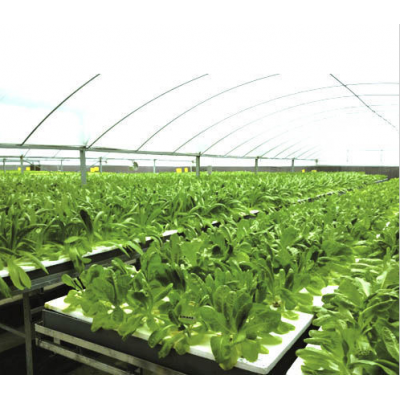
The saving is real but it depends on the layout being right. Filters and the main hose are what keep the emitters working, and a line that has been laid too long for the pressure available will water the near end of the block and starve the far end, which is the mistake worth avoiding at the design stage rather than in the season. A line laid out with drip in a greenhouse crop is described in the irrigation and hydroponics system.

The table below is the standard kit. Block size, sectioning and the fittings are set to the site and to the crop.
| Function | Drip irrigation |
| Product name | Built-in drip irrigation tape |
| Usage | Water saving irrigation system |
| Application | Agricultural irrigation |
| Kit coverage | Five hectares per kit, set out to the block |
| Kit contents | Main hose, drip tape, filters, valves and fittings |
| Control | Blocks run in sections from the valve manifold |
| Support | Online technical support |
| Crops | Vegetables, maize, fruit, herbs and flowers |
| Customisation | Block size, sectioning and fittings set to the site |

The kit arrives as hose, tape, fittings and valves, and is assembled in the field rather than fabricated. The main hose is laid along the headland and the valve manifold is set at the supply point first, because the sectioning decides how the block is watered, then the tape is connected and run out along each row.
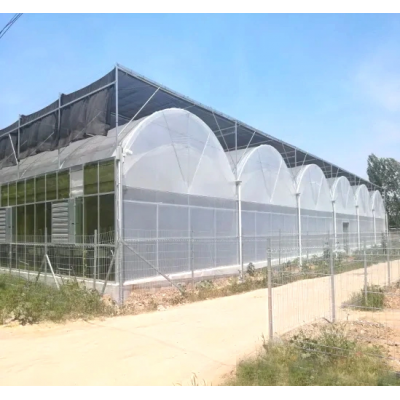
Maintenance is mostly about keeping the emitters open. Filters are cleaned on a cycle through the season, the lines are flushed at the end of a run so sediment does not settle at the far end, and the tape is lifted and stored rather than left in the ground where it will be cut by the next pass of machinery. A system that fits the same crop under cover is described in the drip irrigation system.

Kits of this type are used on vegetable blocks, on maize and other field crops, and on fruit and flower plantings where water has to be applied to the root zone rather than over the canopy. They suit commercial growers watering a block of several hectares, farms that are short of water or of labour and want to recirculate the effort, and operations that expect to add dosing, monitoring or a control layer to the same layout later.
Research and extension material on irrigation scheduling and on protected crop production is published by Michigan State University through its horticulture department. Production and technical reporting for commercial growers is published by Greenhouse Grower. The specification that matters is the one that still suits the crop ten years from now.
Because it is a consumable and the field is worked. The tape is laid along the beds for the season and lifted at the end of it, so the capital sits in the main hose, the filters and the valves, and the lines are replaced rather than repaired in the ground.
The flow and the pressure available at the supply. A run that is too long for the pressure will water the near end of the block and starve the far end, so the block is split into sections at the valve manifold and run a section at a time.
The hose, filters and valves are built for long service with the maintenance schedule above. The tape is a consumable and is replaced on the cycle the crop and the machinery impose on it.
We provide a 10 year structural warranty and a 5 year anti-corrosion warranty on the galvanized and metal parts. Details are set out in the contract for each project.
Send your block dimensions, the crop and row spacing and the water source you have. We reply with a layout drawing and a full quotation.