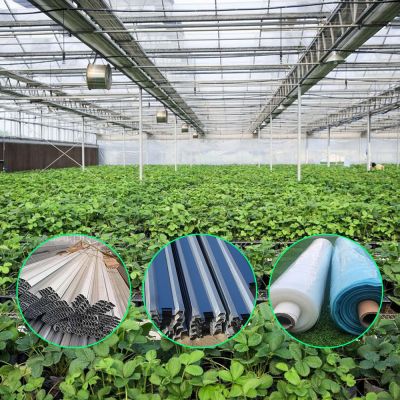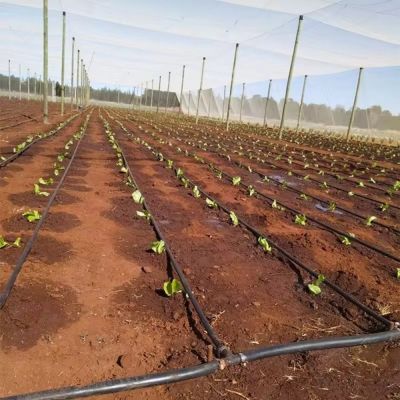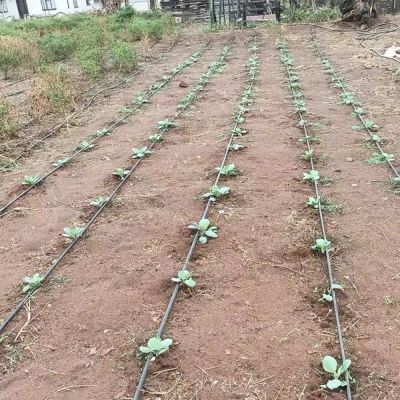


This is the whole system for a block rather than the tape on its own: the tape, the mainline it connects to, the fittings and the flush valves, sized so that one kit covers a hectare of row crop. The emitters run at 1.5 litres per hour and are spaced 20 centimetres apart, which is what decides whether the wetted band is continuous along the row. Because the water goes into the soil at the plant rather than over the canopy, there is no evaporation loss from the surface and the leaf stays dry.
A drip kit is bought when the block is being laid out from scratch, because the parts have to agree: the mainline has to carry the flow for the number of lines on it, the fittings have to match the tape diameter, and the flush valves have to be at the far end of every run. Buying them as one set removes those mismatches.
The set is the tape, the mainline hose, the connectors and the flush valves, sized against onehectare. That quantity is what makes it a kit rather than a roll: a hectare at normal row spacing takesa defined length of tape and a defined length of mainline, and the two are quoted together so the blockis not half irrigated while a second order is placed.
Because the tape is flexible rather than rigid, the lines follow the ground. A block that is notlevelled still gets a wetted band along the whole row instead of water collecting only in the lowcorner, which is the practical difference between tape and buried rigid pipe. Kits of this type sitwith the rest of the irrigation system range on this site.

The emitters run at 1.5 litres per hour and are set 20 centimetres apart. The spacing is the figurethat decides whether the wetting is continuous: at a close spacing the water from adjacent emittersmerges into a band along the row, and at a wider one the crop sees separate wet spots with dry soilbetween them.
The spacing is chosen against the soil rather than the crop alone. A sandy soil spreads watersideways far less than a clay one, so a spacing that gives a continuous band on one field leaves dryshoulders on the next, and the same kit is supplied with different spacing on the order.

Water is delivered into the soil at the plant rather than over the top of it. That removes the twolosses that overhead irrigation carries: the evaporation from a wetted surface, and the run off thatfollows when the application rate exceeds what the soil can take.
Keeping the canopy dry is the second effect, and on a crop where leaf disease is the limitingfactor it is the reason for choosing drip at all. A dry leaf removes the condition a fungal problemneeds, which costs less than treating it. Filtration ahead of the tape is part of the kit, because theemitter passage is small.

| Function | Drip irrigation |
| Product | Built in drip irrigation tape kit |
| Coverage | 1 hectare |
| Tape | 16 mm LDPE, UV resistant |
| Emitter flow | 1.5 L/h per emitter |
| Emitter spacing | 20 cm |
| Kit contents | Tape, mainline hose, connectors and flush valves |
| Water delivery | At the root, below the canopy |
| Packing | Cartons |
| Crops | Tomato, melon, vegetables and row crops |
| Customisation | Emitter spacing, wall thickness and flow rate set on the order |

The mainline goes in first and the tape is run off it along each row, with the far ends closed bythe flush valves. Lines are laid with the emitters facing up so they are not pressed into the soil, andevery run is flushed before the crop is planted so debris from the installation leaves the line beforethe emitters are working against a root.
Maintenance is the filters and the flush. The filter is cleaned on a short cycle, because theemitter passage is small and a partly blocked filter shortens the line at the far end of the blockfirst. The valves are opened and the lines flushed at the start and end of each season, and on a tapethat is being lifted it is rolled and stored out of the sun rather than left on the ground.

Kits of this type are used for open field vegetable and row crop irrigation, for orchards andvineyards where the line runs along the tree row, and for any block where the water supply is meteredor limited. They suit a grower moving from furrow or overhead irrigation, an operation laying out ahectare block for the first time, and distributors supplying the tape and the fittings together againsta block area. A tape supplied on its own by length is described in the flexible 16mm drip tape page.
Industry news and standards work for commercial horticulture is published by AIPH. Production and technical reporting for commercial growers is published by GrowerTalks. A drip tape kit supplied for a farm block is described in the one hectare farm drip irrigation kit page.
Whether the wetted band is continuous along the row. At a close spacing the water from adjacentemitters merges into one band; at a wider one the crop sees separate wet spots with dry soil betweenthem, which is why the spacing is set against the soil as well as the crop.
Because the water goes into the soil at the plant. That removes the evaporation from a wettedsurface and the run off from a blocked soil surface, and it keeps the leaf dry, which takes away thecondition most leaf disease needs.
The tape is UV stabilised and runs for around three seasons in the field, depending on wallthickness. The mainline, filters and valves run on their own service cycles and are replaced as theycome due.
We provide a 10 year structural warranty and a 5 year anti-corrosion warranty on the galvanized steelwork used in the supporting equipment. Details are set out in the contract for each project.
Send your block area, the crop you plan to run and your soil type. We reply with a layout drawing and a full quotation.