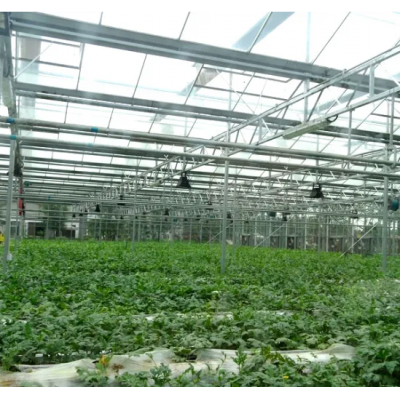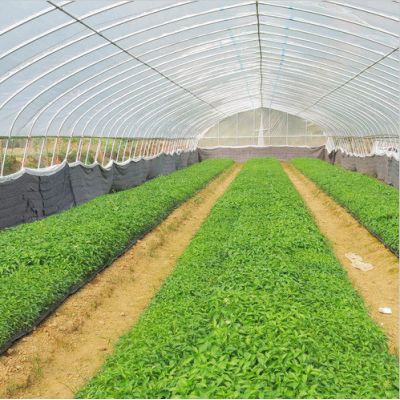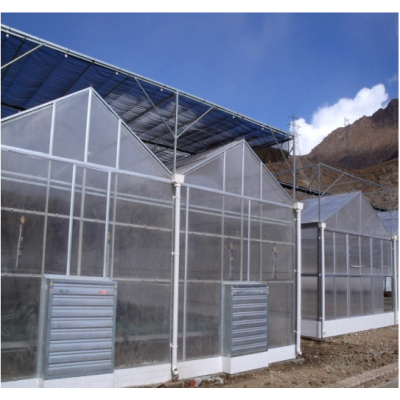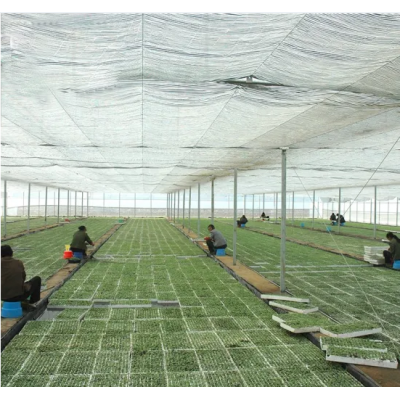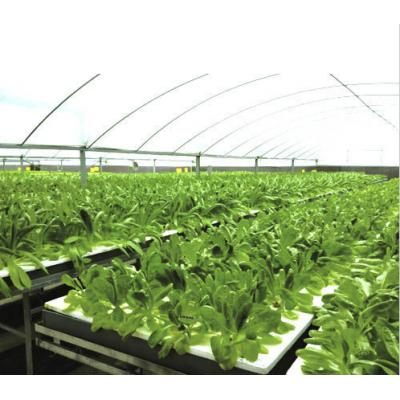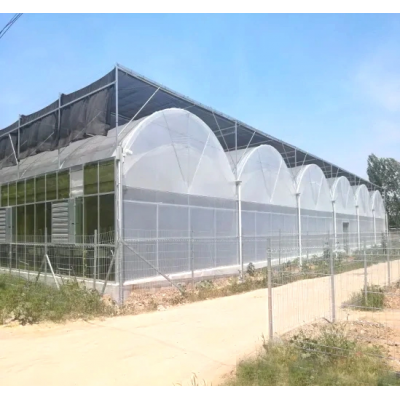


A wet curtain cooling system moves air through a wetted pad wall, and the evaporation that happens on the way through takes heat out of the air before it reaches the crop. The package is simple: exhaust fans at one end of the house, a wetted curtain at the other, and a water supply, pump and drainage circuit that keeps the pad wet without wasting water. Because the fans pull air along the full length of the house, the whole crop sees cooler air rather than just the plants nearest the pad. Pad area, fan capacity and flow rate are set from the house volume, the crop and the local summer climate.
A greenhouse in a hot climate fails in one direction: the crop overheats, the flowers abort and the fruit never fills. Ventilation alone only moves outside air around, and on the hottest afternoons that air is already too warm. A wet curtain cooling system attacks the problem differently, by cooling the air itself before it reaches the plants.
The house is closed on three sides and opened at the pad wall. Exhaust fans at the far end pull air out, which lowers the pressure inside and draws outside air in through the wetted curtain. As that air passes through the wet pad, water evaporates into it and the air arrives cooler than it started. The bigger the house and the drier the outside air, the more the system has to work with, which is why the same equipment performs differently in a humid coastal site and a dry inland one.
The package is made up of the wet curtains and their frames, the exhaust fans, the water supply and distribution pipe, the pump and tank, the drainage and return circuit, and the controls that start the fans and wet the pad on a cycle. Because the circuit is closed, water is recirculated rather than run to waste. Cooling, ventilation, irrigation and shading are usually designed together so the curtain does not fight the venting system.
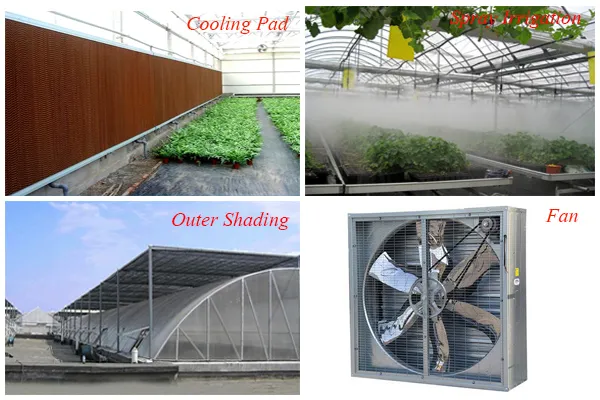
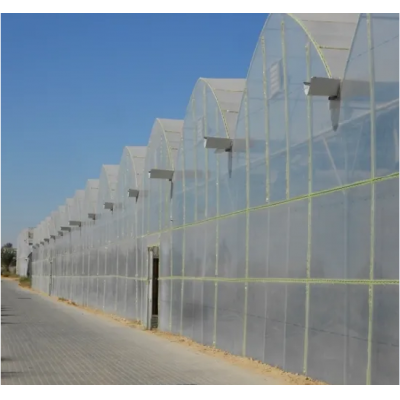
Pad area, fan capacity and air change rate are calculated from the house volume, the length of the air path and the summer conditions on your site. Installation is straightforward but unforgiving about one thing: the house has to be reasonably airtight for the pressure difference to build. Gaps at doors, gutters and film edges pull uncooled air straight past the crop. Where the air path is very long, circulation fans along the ridge even out the temperature between the pad end and the fan end - our circulation fans for greenhouses are normally specified with the cooling package for that reason.
The pad only works while water can evaporate from its surface, so scale, algae and dust are the real enemies. Roof the pad intake or fit a screen so debris cannot be drawn in, keep the circulation water clean, and drain the pad at the end of the season rather than leaving it wet. Check the distribution pipe for blocked holes and confirm the pad is wetted evenly top to bottom. Fans need their belts, bearings and shutters checked on the same rounds as the rest of the climate equipment.
A wet curtain system is standard in vegetable, flower and seedling houses in hot and dry regions, and it is often installed together with the structure rather than later - see the full greenhouse cooling systems range, or compare a house that relies on opening vents alone in the greenhouse with vent system. Cooling is about heat and water together, so USDA publishes guidance on farm water management, and FreshPlaza reports on protected cropping in warm climates.
The reduction depends on the outside humidity. In dry air a large part of the temperature difference between dry and wet bulb can be recovered, while in humid coastal air the same system does less. Because of that we size pad area and fan capacity from your summer climate and house volume rather than quoting a fixed number of degrees.
Clean water with low hardness gives the longest pad life, because scale and algae are what block evaporation. Keep the circulation water clean, protect the pad intake from debris and dust, and drain the pad at the end of the season instead of leaving it standing wet.
The hot-dip galvanized steel frame is designed for a 15-20 year service life in normal agricultural environments, with a double-sided zinc coating of 200-275 g/m². Film covers are replaced every 3-5 years, while glass and PC panels carry their own manufacturer warranties.
The hot-dip galvanized steel frame carries a 10-year structural warranty covering structural safety, plus a 5-year warranty against corrosion perforation. It is designed for a 15-20 year service life, and film covers carry a 3-5 year UV warranty depending on grade.
Send the house dimensions and volume, the crop you grow, and your summer temperature and humidity range. That is enough for us to size the pad area, the fan capacity and the water circuit, and to return a quotation with a layout drawing and a bill of materials.