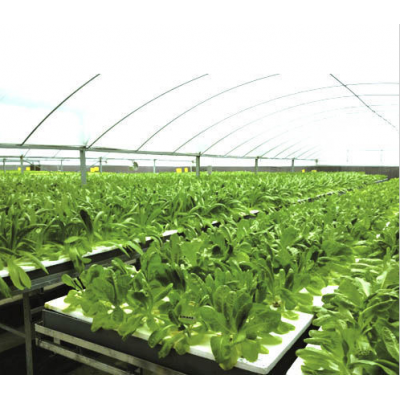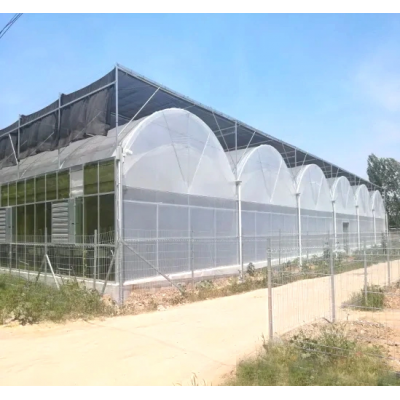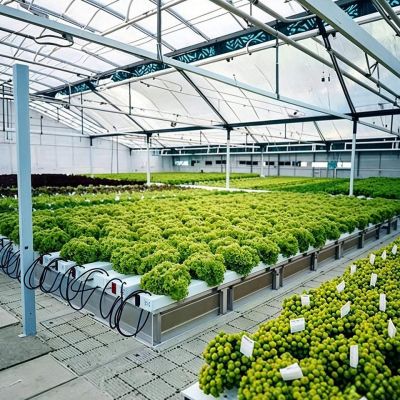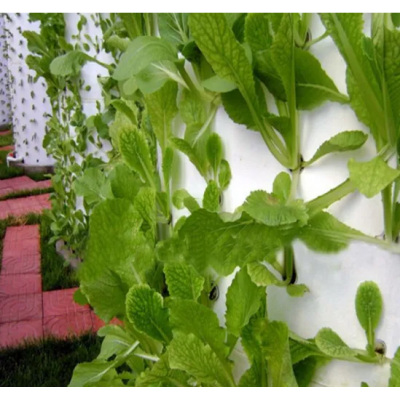


This is a growing system with a control layer built into it rather than added afterwards. The solution is recirculated through the channels, the strength and the acidity are read by sensors in the loop, and the readings are reported so the mix can be corrected without walking the house. Dosing, irrigation and the lighting cycle run from the same controller. The point is not novelty: on a commercial block the value of monitoring is that a drift in the solution shows up as a reading before it shows up as a difference between one end of the house and the other.
Most hydroponic systems are built to deliver solution and then left to be supervised. This one is built to be read. Sensors sit in the loop, the readings go to a controller and to a screen, and the dosing, the irrigation and the lighting cycle respond to what the readings say rather than to a fixed timetable.
The controller holds the set points and acts on them. Nutrient strength and acidity are read continuously, the dosing pumps correct the mix when a reading drifts, and the irrigation cycle is called by the same logic. Because the lighting cycle is on the controller as well, the crop can be run to a day length rather than to the season, which is what makes year round production a schedule rather than a hope.
The second half of the control layer is reporting. Readings are logged and sent to a screen or to the cloud, so a grower can see a trend instead of a snapshot. On a block of any size that is what turns maintenance from a walk round into a task: the drift is visible before the crop shows it.

The sensors are the part that has to be trusted, so they are positioned in the flow rather than in a corner of the tank, and they are calibrated on a routine rather than once. A reading that is drifting is worse than no reading on a system that doses automatically, because the controller will act on it.
Remote adjustment is the other half. Set points can be changed from a phone or an office rather than from the head of the house, which matters on a site where the grower is not on the property through the day. The same connection shows the current readings and the recent history, so a change can be made on the trend rather than on a single number.

Solution that the crop does not take up is collected and returned to the tank rather than drained, so the water the system uses is the water that evaporates and what the crop holds. On a closed loop the strength of the solution is not simply what was mixed at the start, because it changes as the crop takes water and nutrients at different rates, which is precisely why the reading matters.
Channels are white food grade PVC, 1.8 mm to 2.0 mm thick, in 2.9 m and 5.8 m lengths or cut to order, and can be set as one flat layer or stacked in several layers. The frames are galvanized steel. Systems of this arrangement are grouped on the hydroponics system range on this site, and a system built around the nutrient film technique rather than a control layer is described in the nutrient film technique hydroponic farming system page.

The table below is the standard build. Channel count, layer arrangement and the control package are set to the house and to the crop.
| Growing method | Recirculating hydroponics, soilless |
| Control | pH and EC sensors with dosing on set points |
| Monitoring | Cloud reporting with remote set point adjustment |
| Automation | Dosing, irrigation and lighting cycle on one controller |
| Channel material | Food grade PVC |
| Channel thickness | 1.8 mm to 2.0 mm |
| Channel length | 2.9 m, 5.8 m or cut to order |
| Channel colour | White |
| Layer arrangement | One flat layer or multiple layers |
| Support pipes | Galvanized steel pipes |
| Water system | Recirculating; deep water culture or aquaponic loop |
| Climate | Runs in an enclosed house or sealed grow room |
| Crops | Lettuce, leafy vegetables, herbs, flowers and microgreens |
| Customisation | Channel count, layers and control package set to the site |

The channels and frames are set out to the layout first, the tank and the return are connected, then the sensors are installed in the flow and the controller is commissioned. Set points are entered once the system is wet, because they are read against a running loop rather than a static one. The dosing pumps are calibrated at commissioning and the calibration is repeated on a routine.
Upkeep on a monitored system divides into the mechanical and the measured. Filters and the pump intake are cleaned on a short cycle, since a partly blocked filter changes the flow at the far end of a run before anything the controller can see changes. Sensors are calibrated on their own schedule and replaced when they stop holding a reading. Channels and the tank are washed between crops so root material does not carry over, and the controller log is checked after each crop change to see what the season actually did.

Systems of this type are used for lettuce and leafy vegetable production on a short cycle, for herb and microgreen programmes where the crop is cut rather than picked over, and for sealed rooms where the growing environment is set by the equipment rather than by the weather. They suit commercial growers running several houses from one control point, operations that want the water and the nutrients accounted for, and projects where the growing system is specified before the building. A house built around a smart control layer over the same growing system is described in the controlled smart greenhouse for commercial hydroponic production page.
Information and programmes on controlled environment production are published by the United States Department of Agriculture. Farming and horticulture reporting for growers in South Asia is published by Agriculture India.
Nutrient strength and acidity. The readings go to the controller, which corrects the mix with the dosing pumps when a reading drifts off its set point, rather than waiting for a grower to test the tank and adjust it by hand.
Because the correction often has to happen when nobody is on site. Set points can be changed from a phone against the recent trend rather than a single reading, which is a different decision from the one made standing at the tank.
The galvanized support steel is rated for 15 to 20 years under normal growing conditions. The sensors, dosing pumps, controller and channel set run on their own service cycles and are replaced as they come due.
We provide a 10 year structural warranty and a 5 year anti-corrosion warranty on the galvanized steelwork. Details are set out in the contract for each project.
Send your house dimensions, the crop you plan to run and the growing layout you intend to use. We reply with a layout drawing and a full quotation.