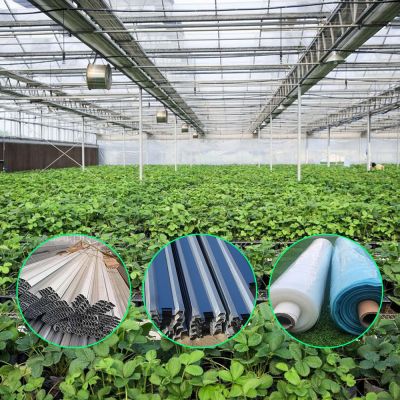


The section is square rather than round, and that is the whole reason to specify it. A square tube presents four flat faces, so a bracket, a clamp or a frame gusset sits flat against the steel instead of being fitted to a curve, and the section resists twisting along its length far better than a round tube of the same weight. On a frame that has to stay square, that stiffness is what keeps the geometry after a few seasons of wind load. The pipe is hot rolled to ASTM standard and then hot dip galvanized, so the zinc reaches every face and the cut ends. Bundled with steel strips and wrapped in plastic film for shipping.
Square tube and round tube carry the same steel, so the choice between them is not about strength in the abstract. It is about how a joint goes together and whether the frame stays square. Both questions are answered by the shape of the section rather than by the amount of metal in it.
A square tube presents a flat face on every side, so a bracket sits on it, a clamp grips it without slipping round, and a corner joint can be bolted through two flat surfaces rather than fitted to a curve. That is the practical difference on a frame that has to be assembled on site without a jig, and it is why square sections are used for door frames, bracing and columns even where a round tube would carry the same load.
The second difference is torsional stiffness. A closed square section resists twisting along its length more effectively than a round tube of comparable weight, so a frame built from it holds its geometry under load instead of racking. A round pipe range for arches and hoops is described in the hot dip galvanized round steel pipe for greenhouse frames.

The tube is hot dip galvanized after forming, so the zinc is metallurgically bonded to the steel rather than applied as a surface coat, and it reaches the inside of the section, the cut ends and the wall of every drilled hole. On a frame that stands outdoors, those are the three points that fail first: water collects inside a closed section, the cut end has no coating of its own, and a drilled hole exposes bare metal at exactly the place a bolt will hold moisture against it.
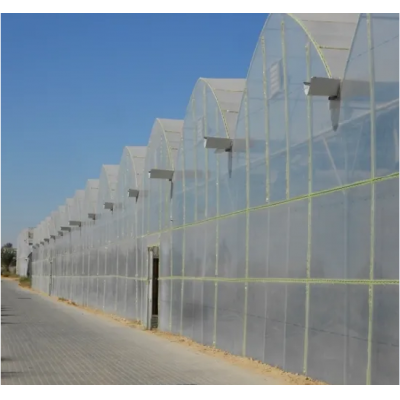
A square section is more prone to internal condensation than an open profile because the void is sealed, which is the other reason the coating has to be applied by dipping rather than spraying. Where a member is cut on site, the exposed face takes a cold galvanizing repair compound, and any hole drilled on site is treated the same way. The same coating discipline applies to the square profile tunnel frame described in the square profile PE film tunnel greenhouse.

Section size and wall thickness are set to the duty rather than fixed across a range: a brace takes a lighter wall than a main column, and a main column on an exposed site takes a heavier one than the same column in a sheltered valley. What decides the specification is the span or the height the member carries, the wind and snow load at the site, and the load hanging from it.
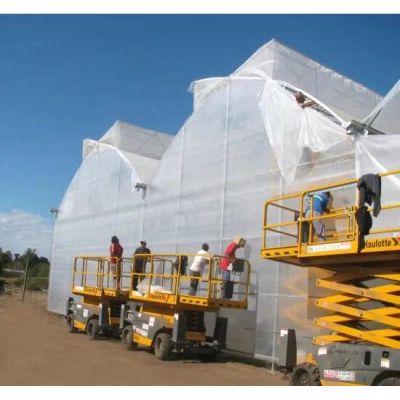
Because the faces are flat, cutting and drilling are straightforward: a square tube can be cut square on a mitre saw and drilled on a bench, and the holes line up with a bracket without a jig. Members are bolted rather than welded, which keeps the coating whole at the connection and allows a damaged length to be unbolted and replaced. Where welding is required, the weld and the surrounding zinc are re-treated afterwards. The film houses these frames go into are listed on the film greenhouse range page on this site.

The table below is the standard supply. Section, wall thickness and length are set to the frame drawing.
| Product | Hot dip galvanized square steel pipe |
| Section | Square; rectangular, round and hydraulic sections also available |
| Wall thickness | Matched to the duty, from light bracing to main columns |
| Technique | Hot rolled, non alloy, hot dip galvanized finish |
| Standard | ASTM |
| Coating | Zinc coating on all four faces, the bore and the cut ends |
| Processing service | Bending, welding, cutting and OEM to drawing |
| Length | Cut to the frame drawing |
| Packing | Bundled with steel strips, wrapped in plastic film |
| Applications | Structural frameworks, greenhouse bracing, fencing and construction |

Pipe is supplied in bundles held with steel strips and wrapped in plastic film, which is what keeps the coating intact through a container and a yard before the frame is raised. Cut ends are the part to watch on arrival: a bundle that has been dragged rather than lifted will show bright metal at the ends, and that is where rust starts. Handling with slings rather than forks is worth insisting on, and bundles are stored off the ground so the bottom layer is not sitting in water.
Fabrication should be planned so that cutting and drilling happen before galvanizing rather than after. Where a member has to be shortened on site, the exposed face is treated with a cold galvanizing repair compound, and the same applies to any hole drilled on the site. The frame is then assembled with bolts and clamps rather than welded, which is what keeps the coating whole at every connection.

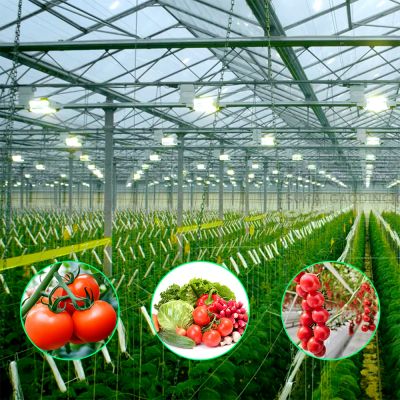
Square galvanized tube is used for greenhouse columns, bracing and door frames, for the legs and rails of benching and trolleys, for fence posts and gates, and for general structural framing in agricultural and construction work. It suits frames that have to be assembled on site from cut lengths, and projects where the joint detail matters as much as the load the member carries.
Research and extension material on protected agriculture, including work on structures and on the growing environment, is published by UF/IFAS, the University of Florida Institute of Food and Agricultural Sciences. Commodity and market reporting for agricultural buyers, covering prices and production, is published by Agriwatch. The question that decides the specification is normally the frame that will be standing in ten years, not only the order in hand.

When the joint has to sit flat or the frame has to stay square. A flat face takes a bracket, a clamp or a gusset without a shaped fitting, and a closed square section resists twisting along its length better than a round tube of comparable weight. Round tube remains the sensible choice for arches and hoops.
Because a square section is closed, so the inside face is the part that cannot be reached by spraying and the part where condensation collects. Hot dipping coats the bore, the four outer faces and the cut ends in one operation, which is why it is specified for tube that will stand outdoors.
Hot dip galvanized steel used in a structural or greenhouse frame is rated for 15 to 20 years under normal conditions, with a 5 year anti-corrosion warranty on the coating. Where a member is cut on site, the cut face is treated with a cold galvanizing repair compound.
We provide a 5 year anti-corrosion warranty on the galvanized coating, and the structural warranty on the finished frame is 10 years. Details are set out in the contract for each project.
Send the section sizes you need, the wall thicknesses, the cut lengths and the quantities. We reply with a full quotation and a delivery schedule.