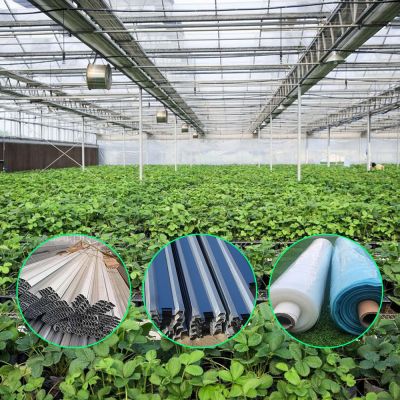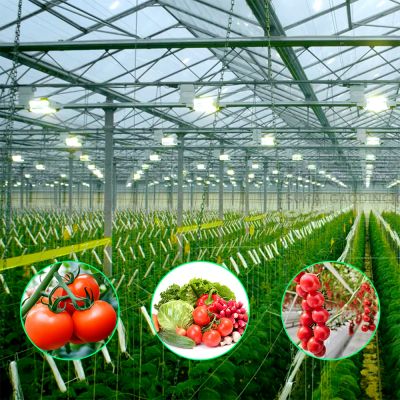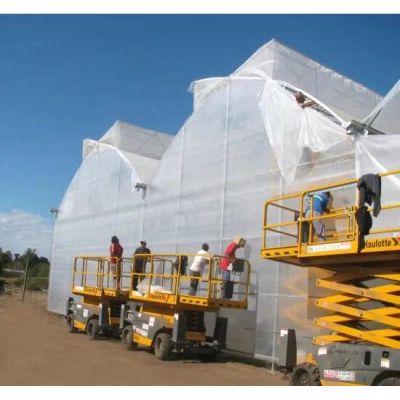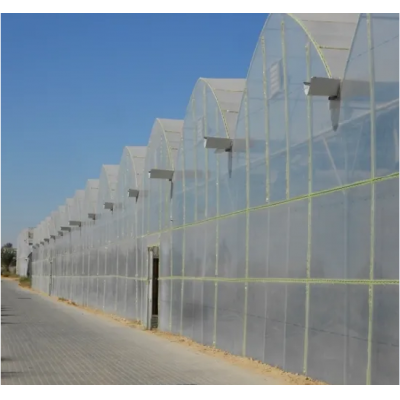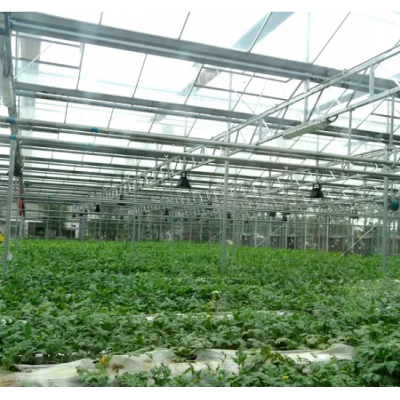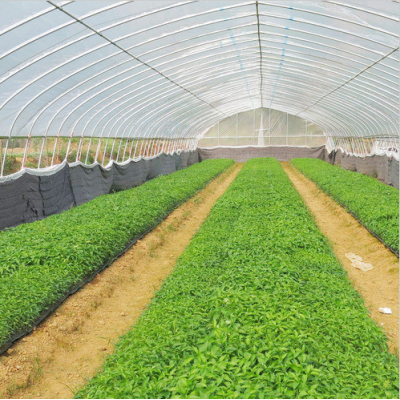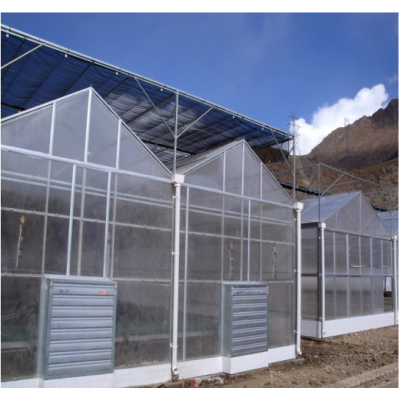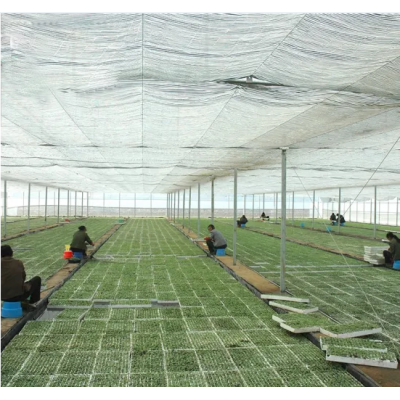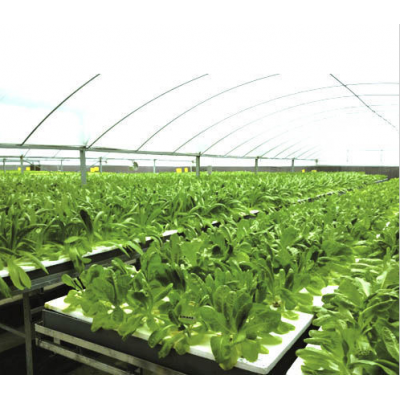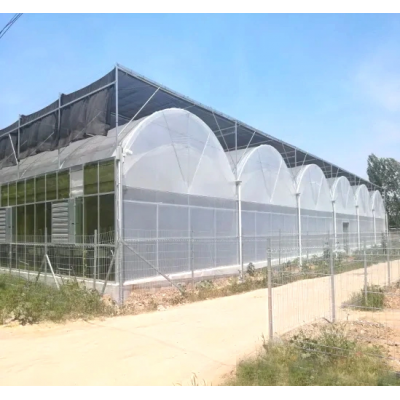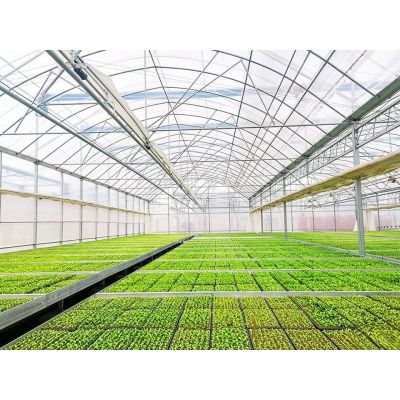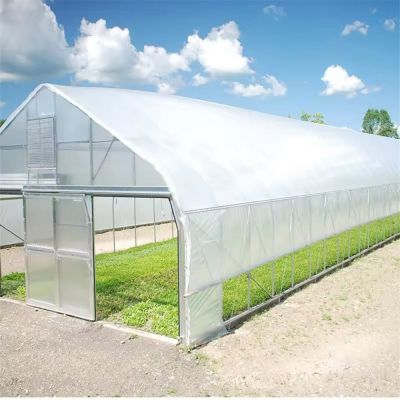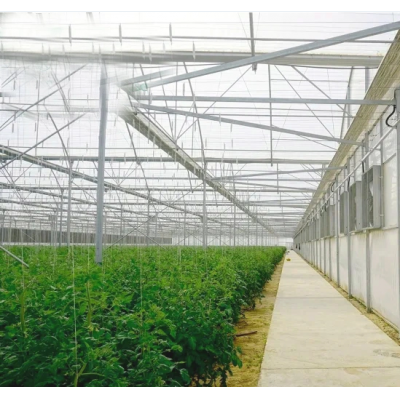


This house is a multi span film greenhouse fitted with a thermal curtain, so the crop is not starting from cold every morning. The curtain is a separate layer carried under the roof on its own rails and drawn across in the evening, which holds the warmth the house collected during the day instead of letting it leave through the cover overnight. The frame is hot dip galvanized steel, bolted rather than welded on site. Spans run from 8 m to 12 m and length from 10 m to 100 m.
Most of the heat a greenhouse collects during the day leaves it again after sunset. On a tomato crop that matters twice over: the plants are reset every night, and the grower either pays to put the heat back in or accepts a slower crop. A thermal curtain is the layer that stands between those two outcomes.
A curtain carried under the roof traps the air between itself and the cover, and that still air is what slows the heat leaving the house. The covering still keeps the weather out and the curtain takes over the job of holding the warmth in, so the two layers are doing separate things rather than one trying to do both.
The effect on the crop is what matters. A house that stays warmer overnight does not restart the crop every morning, so growth is continuous rather than stepped, and the fruit that is ripening sets more evenly down the truss. That is the commercial argument for the extra layer. Houses of this family are grouped on the film greenhouse range page on this site.

The curtain runs on its own rails inside the house, drawn across the bays in the evening and gathered back in the morning. Because it sits inside the film rather than over it, it is not exposed to wind or UV, and the film is free to be specified for weather rather than for insulation.
The frame carries the curtain load as well as the cover, so the rails are hung from the same trusses that carry the roof. On a multi span house the gutter line is the member doing the most work, because it takes the roof water and ties the bays together. A house on the same frame with roll up side walls is described in the commercial multi span house with roll up sides.

A curtain changes the daily routine rather than the crop. The house is closed down in the evening after the vents have done their work, the curtain is drawn to hold the heat, and in the morning the curtain comes back before the vents are opened so the house does not lose the night in the first half hour.
On a tomato crop the same routine decides when the air can be moved. The canopy closes over the rows within a few weeks, and once it closes the layer inside it stops moving on its own, so the openings are worked in stages against the curtain rather than left open all day. A house where the crop is set out for production rather than trial is described in the commercial grade multi span house for vegetables and tomatoes.

The table below is the standard build. Span, length, height, cover and the curtain layout are set to the site and to the crop.
| Greenhouse span | 8 m / 9 m / 10 m / 11 m / 12 m |
| Greenhouse length | 10 m to 100 m, or built to client demand |
| Greenhouse height | 3 m to 8 m, or custom |
| Structure material | Hot dip galvanized steel pipe, bolted assembly |
| Cover material | Three layer compressed PE film |
| Thermal curtain | Separate layer on its own rails under the roof |
| Roof type | Arch roof, multi span, gutter connected between bays |
| Ventilation | Side wall openings at crop height and ridge openings |
| Crops | Tomato, cucumber, leafy vegetables, fruit and flowers |
| Customisation | Span, length, height, cover and curtain layout set to the site |

The kit arrives formed and drilled with the fittings, so the work on site is bolting and tensioning rather than fabrication and no welding is done at any point. Ground posts or a base rail are set to the drawing first, the arches and trusses go up bay by bay, the curtain rails are hung from the trusses, and the film is pulled over last so the curtain is not worked through the cover.
Maintenance is mostly about the curtain and the film. The rail, the edge seal and the running gear are the working parts, so they are checked and greased before the season turns, because a curtain that does not close fully is a night of heat lost rather than a small defect. Film tension is checked after the first season and the cover renewed on a planned cycle.

Houses of this type are used for tomato and cucumber production, for leafy vegetables and for flowering crops where a steady night temperature matters. They suit commercial tomato growers running the house through a cool season, farms that are heating and want to hold the heat they have paid for, and operations that expect to add cooling, lighting or a control layer to the same frame later.
Research and extension material on ornamental and protected horticulture is published by AIPH. Market and price reporting for commercial agriculture is published by Agriwatch. The specification that matters is the one that still suits the crop ten years from now.

By trapping still air between itself and the cover. That layer of air is what slows the heat leaving the house, so the covering can be specified for weather and the curtain takes over the insulation duty at night.
Drawn across in the evening once the vents have finished their work, and gathered back in the morning before the vents are opened, so the house does not lose the night in the first half hour of the day.
The galvanized steel frame is rated for 15 to 20 years under normal growing conditions. The film and the curtain run on their own shorter cycles and are replaced as they come due.
We provide a 10 year structural warranty and a 5 year anti-corrosion warranty on the galvanized frame. Details are set out in the contract for each project.
Send your site dimensions, the crops you plan to grow and your local night temperatures. We reply with a layout drawing and a full quotation.