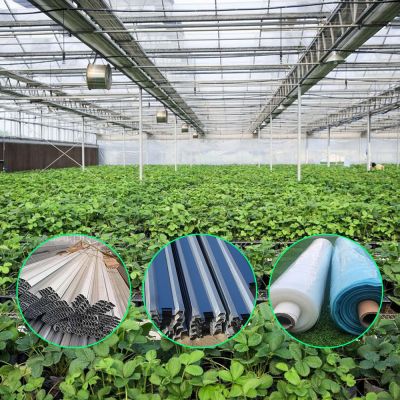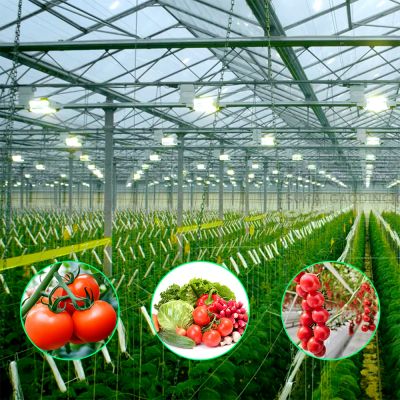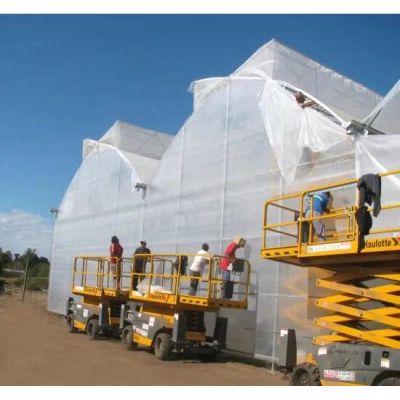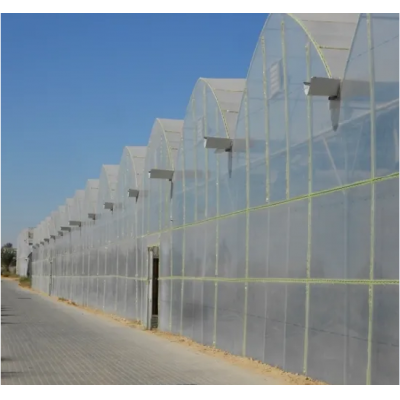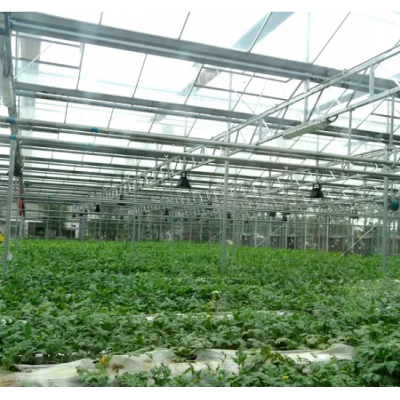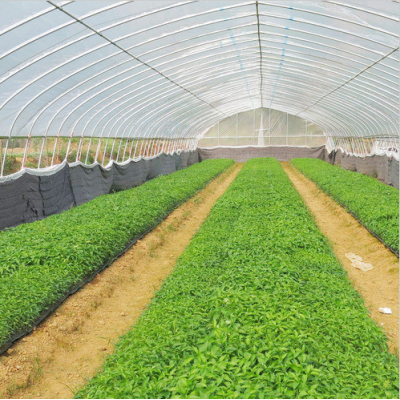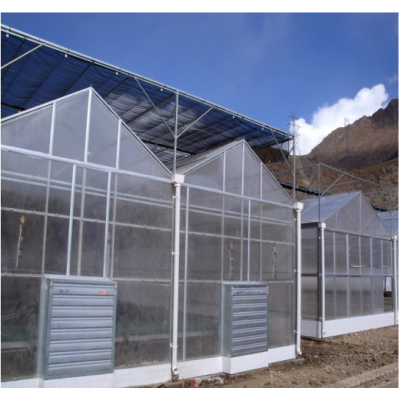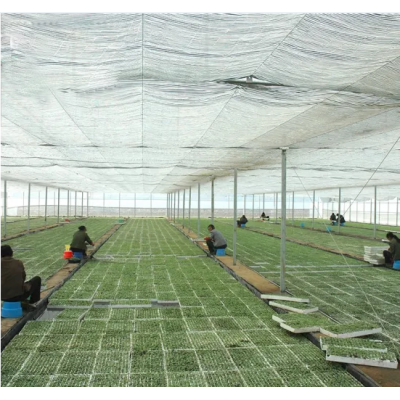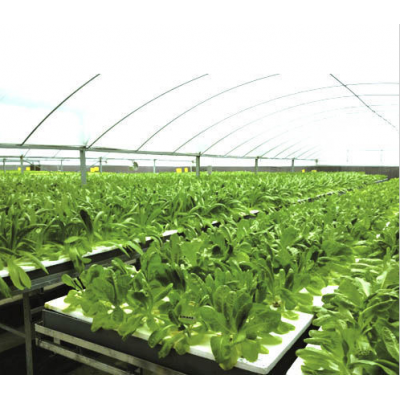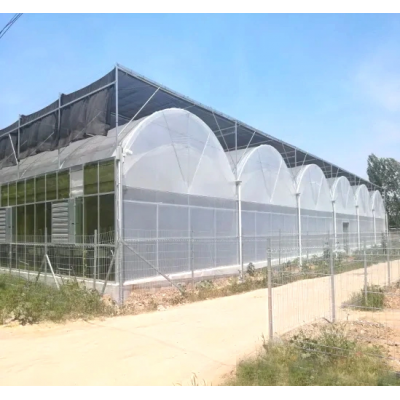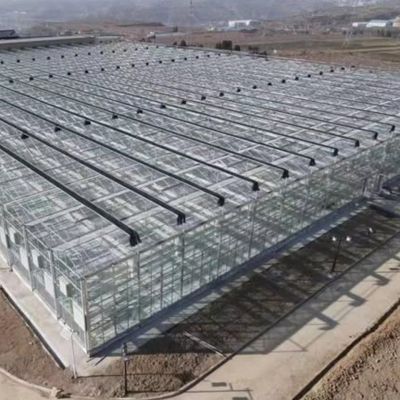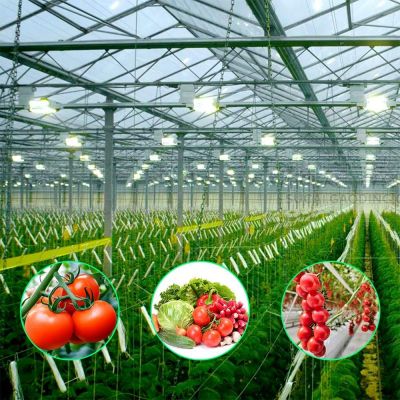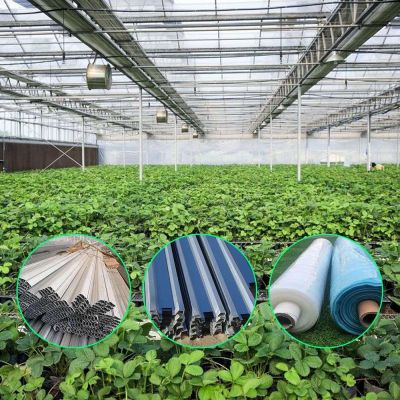


This house is a glass greenhouse laid out around a growing trough system rather than beds, with the troughs carried on galvanized steel frames and the feed run automatically. Glass holds its light transmission over a long service life, which suits a crop that is being fed to a schedule and measured on yield, and it does not move in wind so the readings and the crop are not disturbed by the covering. The troughs are white food grade PVC, raised to a working height so the crop is reached from an aisle.
Putting a growing trough system inside a glass house is a way of fixing both of the things a crop reacts to. The troughs set where the water and the nutrients arrive, and the glass sets what the crop sees above them, so the house and the growing system are specified as one thing rather than two.
In a bed layout the crop sits at floor level, which means the work of planting, pruning and picking is done bent over or kneeling. Raising the troughs onto a frame puts the crop at a working height, so the same job is done standing, and the space underneath can be used for the return pipework and the tanks rather than being wasted.
The troughs also fix the row spacing. Because each one is a separate line, the spacing can be set to the crop and to the aisle rather than to the soil, and a line can be lifted out and cleaned between crops. Houses of this family are grouped on the glass greenhouse range page on this site.

Glass keeps its clarity over a long service life where a film cover degrades and a sheet cover diffuses more heavily. On a house that runs several crops a year and is judged on yield per square metre, that matters, because every season the crop is working under the light the house was specified for rather than under a cover that has aged.
It is also rigid, so the covering does not move in wind and the crop is not shaded by a flapping sheet on a gusty day. The trade is weight, which is why the glazing sits in aluminium profiles and the members that carry it are sized for the load rather than for the cover alone.

The feed is automated, so the crop is watered and fed on a cycle rather than by hand. Solution is mixed in a tank, dosed to a set point and delivered to the troughs, and what the crop does not take up is collected and returned rather than drained away. Under glass that loop is easier to run, because rain does not enter the system and the loss to evaporation is more predictable from one day to the next.
Because every plant on a trough shares the same solution, the system is only as even as its flow. Filters, the pump and the return are the parts that keep it even, and a blocked filter reaches the plants before it reaches an alarm, which is why they are serviced on a schedule. A house built around the structure side of the same combination is described in the steel frame glass house with hydroponic irrigation.

The table below is the standard build. House dimensions, trough spacing and the control package are set to the site and to the crop.
| Greenhouse cover | Glass held in aluminium profiles |
| Trough material | Food grade PVC |
| Trough colour | White |
| Support frame | Galvanized steel pipes |
| Irrigation | Automated feed with dosing and a recirculating return |
| Ventilation | Ridge vents along the bay, run in stages |
| Cooling | Fan and pad cooling system optional |
| Crops | Leafy vegetables, strawberry, herbs, flowers and microgreens |
| Use | Commercial production under glass |
| Customisation | House dimensions, trough spacing and control package set to the site |

The house arrives as formed and drilled steelwork with the glazing, and the trough system as frames, troughs and the control set. Ground posts or a base rail are set to the drawing first, the trusses and the gutter line go up bay by bay, the glazing follows, and the trough frames and the irrigation are set out once the house is closed.
Maintenance divides into the structure, the glazing and the water. Gaskets and clips are checked before the windy season, because a loose pane is a break waiting to happen, and glass is cleaned on a cycle to keep the light level where the crop plan assumes it is. On the water side the filters, the dosing and the return are serviced on the same schedule as the crop, and the troughs are washed between crops so root material does not carry over.

Houses of this type are used for leafy vegetable production on troughs, for strawberry and herb work, and for flowering crops grown to a controlled schedule. They suit commercial growers moving from beds to a raised layout, operations that want the water and the fertiliser recirculated rather than drained, and sites that expect to add cooling, lighting or a larger control layer to the same house later.
Research and extension material on protected crop production, including work on the growing environment under cover, is published by NC State University through its horticultural science department. Production and market reporting for commercial growers is published by Krishijagran. A glass house built around a control layer is described in the sensor driven glass house with app control.
Because the work is done standing rather than bent over, and because the space underneath can carry the return pipework and the tanks instead of being wasted. Each trough is also a separate line, so the spacing follows the crop and a line can be lifted out for cleaning.
Because the light level stays where it was set. Glass holds its clarity over a long service life and does not move in wind, so a crop that is fed to a schedule is also grown under a light level that does not drift as the cover ages.
The steel frame is rated for 15 to 20 years under normal growing conditions. The glazing, the gaskets and the pump and dosing gear run on their own service cycles and are replaced as they come due.
We provide a 10 year structural warranty and a 5 year anti-corrosion warranty on the galvanized steelwork. Details are set out in the contract for each project.
Send your site dimensions, the crop you plan to run and the growing layout you intend to use. We reply with a layout drawing and a full quotation.