
By Alina, Project Engineer, Ziyang Bozong Greenhouse Industry Co., Ltd.
Most greenhouse designs in circulation were drawn for temperate conditions: southern Europe, the Netherlands, northern China. They assume a summer that peaks and a humidity that drops overnight.
Put one of those designs in Ghana, Sri Lanka, Uganda or Malaysia and three separate things go wrong at the same time.
Our own search and inquiry records show where the demand sits. Over the past two years, the buyers asking us about hot and humid conditions came most often from Ghana, Sri Lanka, Uganda, South Africa, Malaysia and Turkey. A grower in Tanzania wrote to us about a strawberry and hydroponics project, wanting to know what would work in his conditions before he committed to a structure. That is the right order to do things in, and it is why this page is written around the problems rather than around a product list.
None of this is a reason to avoid greenhouses in the tropics. It is a reason to specify differently.
A humid tropical greenhouse is one of the harsher environments you can put steel into. Relative humidity sits above 80% for much of the year, condensation forms on the frame and inside hollow sections every night, and temperatures stay above 30 °C.
Fertilizer salts and agricultural chemicals hang in the air. On a coast, add airborne salt to all of that.
Corrosion rates here run several times higher than in temperate open air, and in coastal locations higher again.
What to insist on:
Hot-dip galvanized steel, coated after fabrication, so that cut ends and the insides of hollow sections carry zinc. Pre-galvanized steel leaves cut edges bare, and in a humid house that is where rust begins.
The coating thickness in microns, not just the word "galvanized". For thin-wall tube under ISO 1461 the relevant minimum is 55 μm.
Careful reading of any g/m² figure, because Chinese standards usually quote a double-sided total while international standards quote per side. The same 275 g/m² can mean roughly 39 μm or roughly 19 μm depending on the convention. We have written about how to tell those apart, and it is worth ten minutes before you sign anything.
Saving money on the frame here is the worst economy in the whole project. You cannot retrofit galvanizing onto a greenhouse that is already standing.
In a temperate climate a greenhouse is designed to hold warmth in. In the tropics that same property becomes the problem.
At 35 °C outside, a poorly ventilated house can reach 45 to 50 °C inside. At those temperatures pollination fails, fruit sets badly and many vegetable crops simply stop growing.
What actually works:
Ridge ventilation, and enough of it. Hot air rises and needs an exit at the highest point of the structure. Side vents alone will not clear the heat load. Ask what the total vent area is as a percentage of floor area, and treat a vague answer as a no.
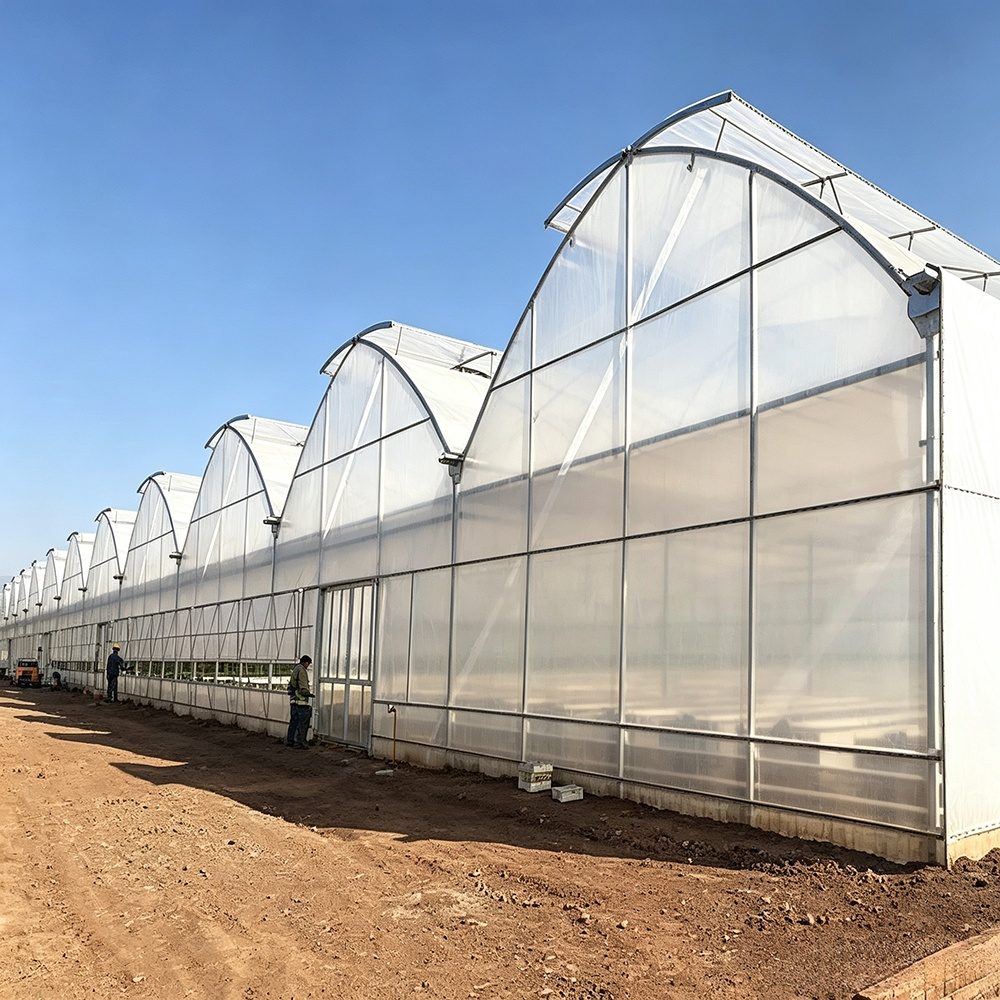
Eave height. More internal volume means a bigger buffer against temperature spikes. Low, tight structures heat up much faster.
Roll-up sides where the crop allows. Across most tropical vegetable operations, open-sided designs with roll-up curtains outperform fully enclosed houses, and you close them only when a storm is coming. That is a general rule with exceptions, and a crop like lettuce behaves differently from a tomato crop under net.
Shading, with the right placement. A 30% to 50% shade net reduces the heat load at source. External shading works better than internal, because it intercepts the sun before the light enters the structure. On a well ventilated house with external shading, indoor temperature can be held to roughly 1 °C above outdoor temperature. That is the difference between a working house and a dead one.
Cooling systems where the crop justifies the cost. Fan and pad cooling works. Our cooling pads are 10 cm or 15 cm thick and made from pure wood pulp rather than the paper cores sold as equivalents, and our axial fans move 45,000 m³/h. But the system consumes water and power every day, so it pays for itself on high-value crops and does not pay for itself on field-scale vegetable production.
High internal humidity is not just uncomfortable. It is the single biggest driver of fungal disease. Downy mildew, powdery mildew, grey mould and bacterial blights all develop when leaves stay wet overnight.
The control strategy is airflow, not chemicals.
Ventilation that exchanges air overnight shortens the time leaves stay wet. Horizontal airflow fans keep air moving through the canopy rather than pooling under it. Drip irrigation instead of overhead watering keeps the foliage dry. Spacing that gives each plant its own air does the rest.
One specification worth more than it costs: anti-dripping treatment on the inner face of the film. Without it, condensation forms as droplets that fall onto the crop, which is the same as overhead watering but worse, because it happens every night at the worst time.
For most commercial vegetable operations in West Africa and South Asia, film is the right cover. It delivers the light the crop needs at a cost a working farm can justify, and the money saved is better spent on a properly galvanized frame and generous ventilation, both of which you keep for the life of the structure.
| Cover | Lifespan | In a hot, humid climate |
|---|---|---|
| Polyethylene film | 3 to 5 years | Cheapest, good light transmission, replace on schedule |
| Polycarbonate sheet | 10 years and up | Better insulation and impact resistance, higher cost, slightly less light |
| Glass | 20 years and up | Longest life and best light, highest cost, and the heavy frame raises corrosion risk |
PC and glass make sense where the crop is high value, where the structure must hold for decades without a film change, or where wind and hail are extreme.
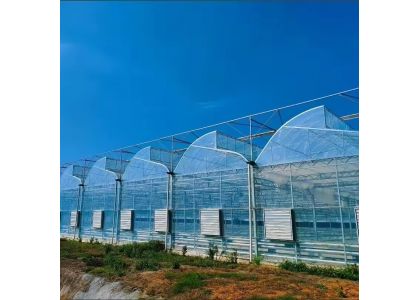
For the structure itself, the model we recommend most often in humid regions is a gothic multi-span house. Span runs from 8 m to 12.8 m, gutter height from 3 m to 6 m, and total ridge height from 5 m to 8.5 m, which gives the internal volume that tropical ventilation needs. The roof form also sheds the heavy rain that a flat or shallow roof handles badly. Where a grower wants to phase investment or test a crop first, a single-span tunnel still makes sense, and those need a foundation base where the tunnel models do not.
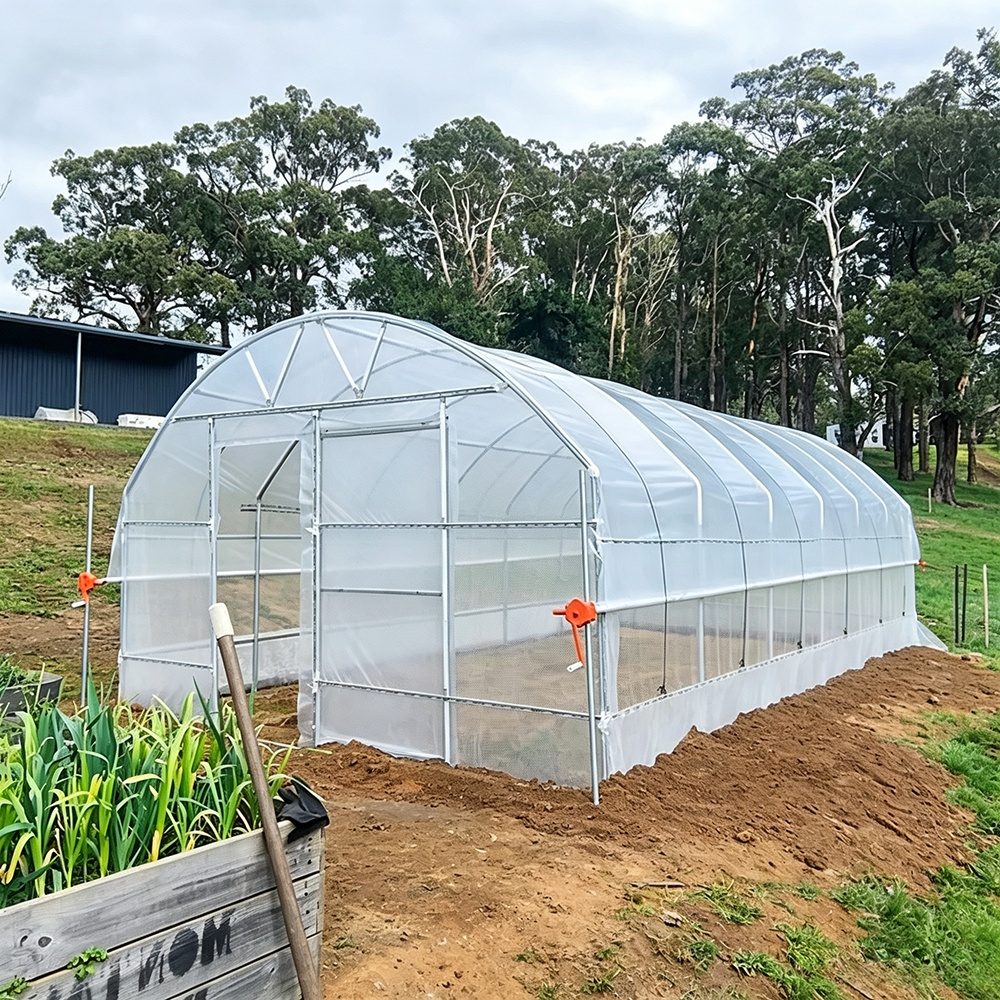
The land argument usually settles the choice. Every separate tunnel has its own walls and the gap between it and the next one. On a row of single tunnels, paths and wall zones can consume 10% to 15% of the site. A multi-span block replaces those walls with shared gutters, and growers moving from single tunnels to a multi-span block typically recover 8% to 12% of the footprint as growing area. On a commercial site that is not a detail.
We have been building greenhouses for more than 35 years from a 180,000 m² factory in Ziyang, Sichuan. Eighteen design engineers work on layouts, and 35 installation engineers travel to sites.
The useful first step is not a price. It is a bay layout drawn for your land, your crop and your rain season, with the ventilation area and eave height marked on it. That is what our design team produces for enquiries, and it is what you should compare against every other quotation you hold. Send us the plot dimensions, your crop, and the months you need the house to perform. We will send the layout and a specification list, and you can check our numbers against the alternatives.
Alina, Project Engineer Ziyang Bozong Greenhouse Industry Co., Ltd. — Sichuan, China


