
Industry News · Ziyang Bozong Greenhouse Industry Co., Ltd.
A greenhouse in a hot climate is judged on the air it can move, not on the equipment bolted to it. Buyers shopping for commercial greenhouse ventilation usually start with fans. It is worth starting one step earlier, with the building itself: a house with well-matched roof and side openings holds a workable climate through most of the year without any powered ventilation.

Two openings do the work, and they do different jobs.
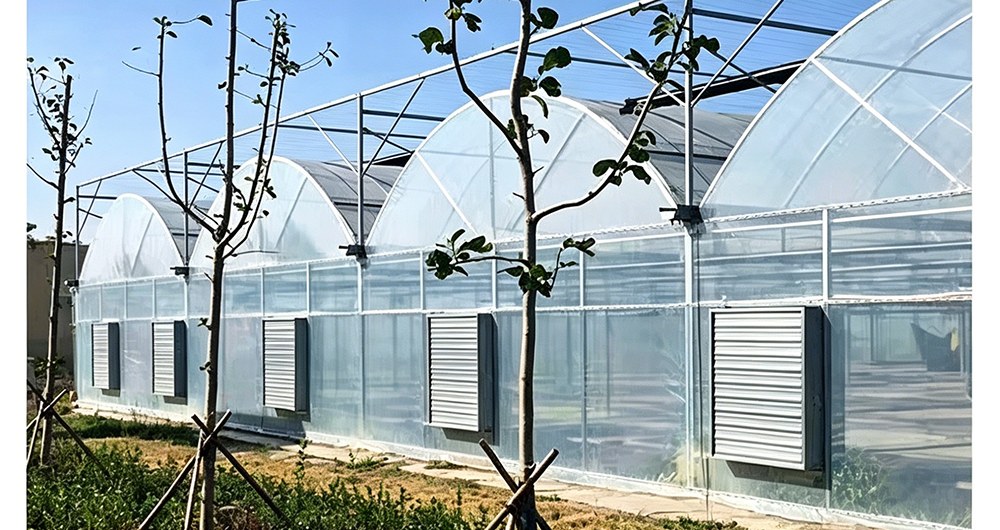
Warm air becomes less dense and rises. It leaves through the highest opening available, which in a film house is the ridge vent. Replacement air has to enter low down, at the side curtain or the sidewall louvre. That loop only runs if both ends are open and both are large enough.
Height gives the house a buffer of air. In a tall structure a slug of hot afternoon air mixes into a larger volume before it reaches the canopy, so the crop feels a slower rise instead of a step change. The same volume holds moisture overnight, which keeps condensation off the leaves for longer and gives the morning vent cycle time to work.
There is a cost side. Every extra metre of ridge carries more steel, presents more surface to wind, and makes the covering harder to tension. Height is a climate decision and a budget decision at the same time, and the right answer depends on the crop and the site rather than on a preferred number.
Ridge vents work on buoyancy. They move air even on a still day, which is exactly the afternoon when a crop is most at risk. Side openings work on wind pressure, so their performance depends on prevailing wind, the orientation of the house, and what stands upwind of it. A windbreak, a tree line or the next house in the block all change the answer. Sized as a pair, the smaller opening sets the limit — an oversized ridge vent above a narrow inlet will not pull more air.
Insect screen changes the arithmetic. A screened opening is not the same opening: the mesh reduces the free area and the airflow through it, so a screened sidewall needs more opening than an unscreened one to pass the same volume of air. Screen is usually added for a crop reason, and it is worth asking what it costs in airflow at the same time.
Ventilation hardware is only as good as the structure it is fixed to. A gutter that deflects under load will bind a rack-and-pinion roof vent. A frame that moves will leave a rolled curtain with gaps at the end wall, and a gap at the end wall is a permanent leak.
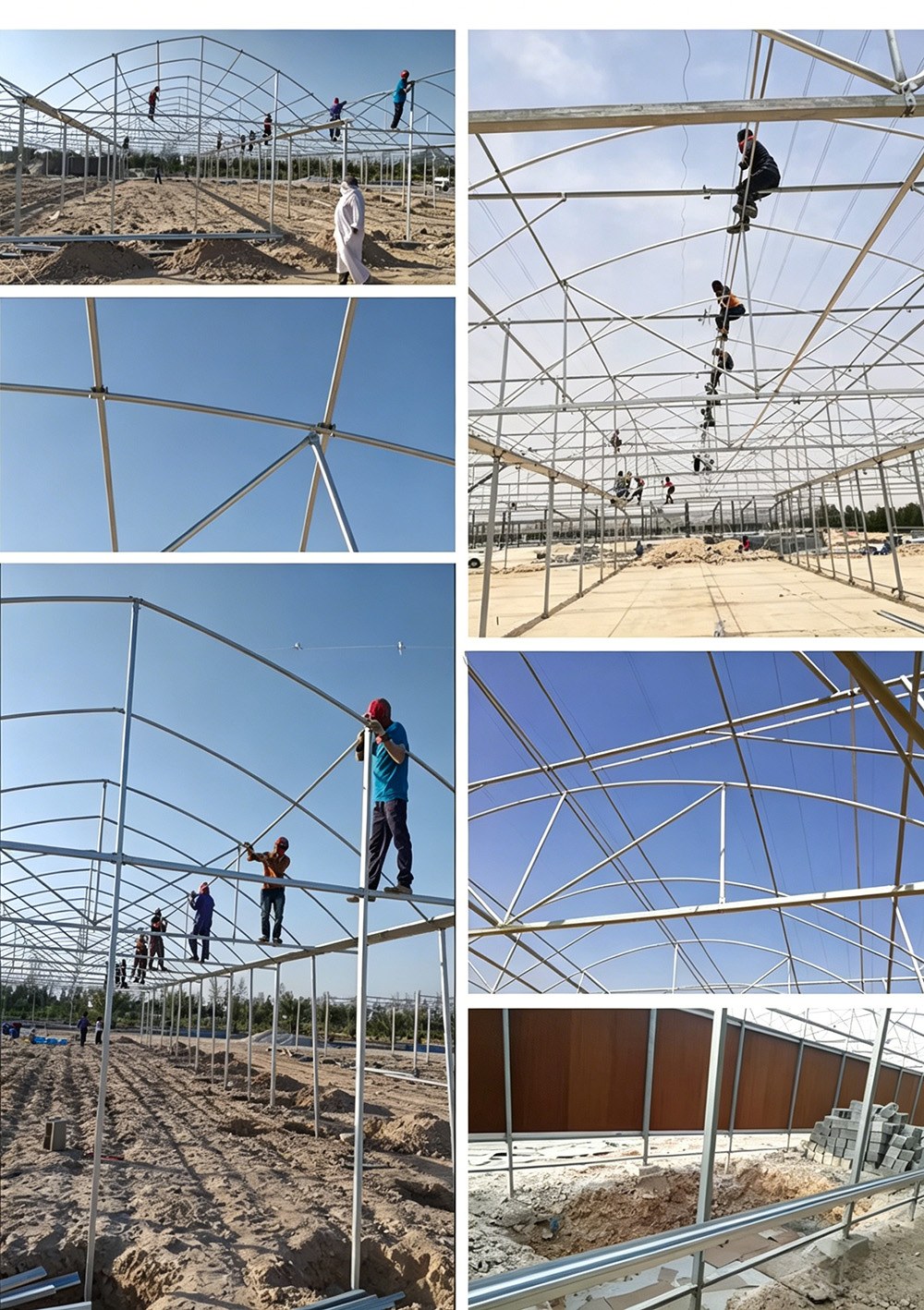
Wind load also sets how much opening you can keep on the windward side in bad weather. On most designs the answer is none, since vents close ahead of a storm. That means the house needs a protocol as well as a mechanism: who closes what, at what forecast, and whether the drive can do it unattended. It is a dull question that decides whether the ventilation survives its first season.
The film cover diffuses light, and diffused light spreads the heat load across the canopy instead of concentrating it in one band of the house. That helps ventilation work, because there is less of a hot spot to shift.
Shade is where the trade-off shows. A fixed net hung inside the house cuts incoming radiation, but it also sits in the air path and cuts the flow. An internal curtain on rails can be retracted at night, when the house needs to dump heat rather than block it. On a hot-climate project the retractable version usually pays for itself in the first season, though it is the more expensive option at order.
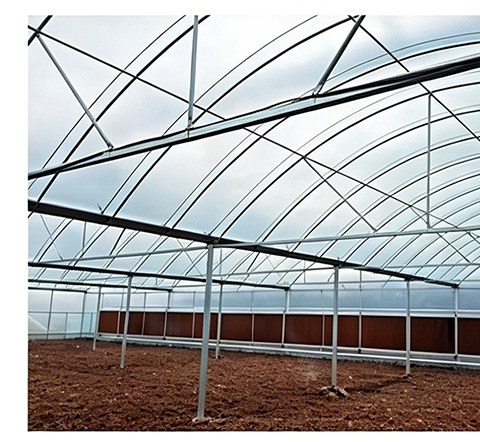
Every layer added under the film, whether a second curtain, a screen or a net, takes free volume and airflow out of the house. Layers should be counted, not stacked.
Powered ventilation is not a repair for a badly ventilated house. It is an addition for sites with long still periods, or for crops that need tighter control of humidity than passive openings can deliver on their own.
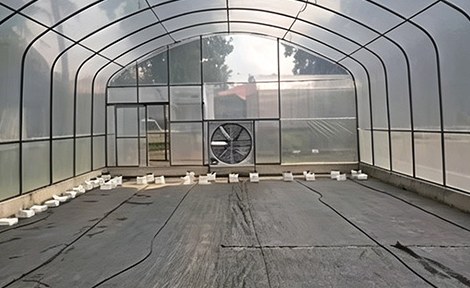
Fans bring a power draw, a maintenance item and a failure mode that passive vents do not have. Decide on them after the passive design is settled, so the question becomes "how much extra" rather than "how do we fix this".
A supplier can only size commercial greenhouse ventilation against real conditions. Useful inputs:
Then ask two questions of the quotation itself. What is the opening area at the ridge and at the side, expressed against the floor area? And what is the design load case with the vents closed? A supplier who can answer both is designing a building. One who cannot is selling a kit.
We build gutter-connected film houses, sawtooth houses and single tunnels, and we set span, bay width and height from the site instead of from a catalogue. The frame is hot-dip galvanized after fabrication, so the cut ends and drilled holes carry zinc like the rest of the tube. Rated wind and snow loads are stated at quotation.
The structure carries a 10-year structural warranty for structural safety and a 5-year warranty against corrosion perforation, and the frame is designed for a 15-20 year service life in normal agricultural environments.
For much of the year, yes, provided the ridge and side openings are sized as a pair and the house is tall enough to buffer the afternoon peak. The weeks that fall outside that range are what fans are for.
Not always. Roof vents work on buoyancy and keep moving air on still days, which is their advantage over side openings. Fans become worth their cost where still, humid periods are long, or where the crop will not tolerate the swing.
Roof vents release hot air upward using buoyancy. Side openings admit cooler outside air using wind pressure. A house needs both, and neither can compensate for an undersized partner.
Ziyang Bozong Greenhouse Industry Co., Ltd. designs and manufactures hot-dip galvanized greenhouse structures and agricultural accessories for commercial growers. Structural standards for greenhouse buildings are published by the National Greenhouse Manufacturers Association; industry coverage of protected cultivation is published by HortiDaily.


